

For masonry contractors, one strong relationship with a general contractor can potentially generate years of projects.
A homeowner may hire you once. A productive general contractor may need masonry work repeatedly for new construction, additions, commercial projects, renovations, chimney work, brick restoration, stone veneer, retaining walls, and site improvements.
That is why networking with general contractors should not simply mean handing out business cards at construction events.
The real objective is:
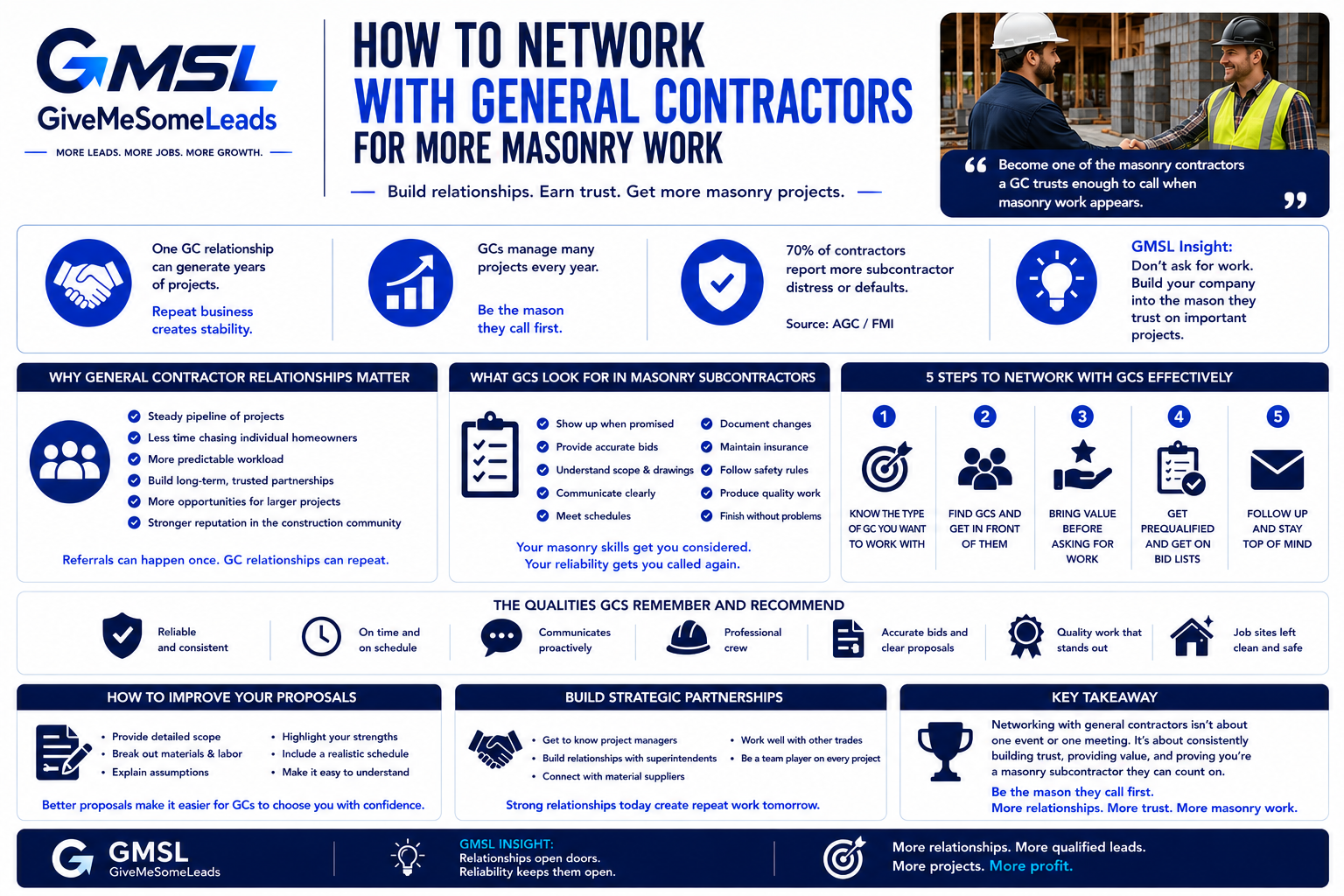
Become one of the masonry contractors a GC trusts enough to call when masonry work appears.
General contractors are responsible for schedules, budgets, clients, safety, quality, and coordination between multiple trades. A subcontractor who does not perform can create problems throughout an entire project.
Masonry Contractor Networking: 25 Ways to Build Better General Contractor Relationships
General contractor relationships can become one of the strongest long term lead sources for masonry contractors.
Direct to homeowner marketing usually works one project at a time. A homeowner needs brick repair, chimney work, stone veneer, restoration, steps, or a retaining wall, then they search online, compare companies, call, and request an estimate.
That kind of lead is valuable, but it is usually tied to one project.
A general contractor relationship can work differently.
One GC may manage 10 projects this year, 20 projects next year, and another 15 projects the year after. If several of those projects require masonry work, one relationship can create multiple opportunities over time.
This does not mean masonry contractors should depend only on GCs. You still need homeowner leads, Local SEO, Google reviews, a strong website, project photos, referral marketing, and other customer acquisition channels.
But strong GC relationships can become another dependable part of your marketing system.
The goal is not to beg for work.
The goal is to become the kind of masonry subcontractor general contractors trust, remember, and want to invite again.
In this guide, we will review 25 ways masonry contractors can build better general contractor relationships, get more bid opportunities, and turn networking into a more predictable source of work.
General contractor networking is not only about meeting people. It is about becoming easy to trust, easy to qualify, easy to communicate with, and easy to hire again.
Understand What General Contractors Actually Want
A general contractor is not simply looking for someone who knows how to lay brick, block, or stone.
They are looking for a subcontractor who makes the project easier to manage.
That is a major difference.
Many masonry contractors focus only on the quality of the finished work. Quality matters, but from the GC’s point of view, the work is only one part of the relationship.
The GC also cares about whether you show up when promised, submit accurate bids, understand the scope, communicate clearly, meet schedules, document changes, follow safety requirements, maintain insurance, coordinate with other trades, and finish without creating problems for the next phase of the project.
- Show up when promised
- Provide accurate bids
- Understand the scope
- Communicate clearly
- Meet schedules
- Document changes
- Maintain insurance
- Follow safety requirements
- Coordinate with other trades
- Finish without creating problems for the next phase
A good mason who causes confusion can still be difficult to use again.
A good mason who makes the GC’s life easier becomes much more valuable.
General contractors are usually managing owners, architects, permits, inspectors, suppliers, change orders, deadlines, budgets, and multiple trades at the same time.
If your masonry company reduces stress instead of adding to it, you become more than a subcontractor.
You become a reliable part of the project system.
That is how repeat relationships are built.
When introducing your company to a GC, do not only talk about your masonry services. Talk about reliability, communication, schedule awareness, clean documentation, and your ability to coordinate with other trades.
Your masonry skills get you considered. Your reliability gets you called again.
Sends a low number with very little detail. The GC has to ask what is included, what is excluded, whether materials are covered, and when the work can start.
Sends a clear proposal with scope, materials, exclusions, schedule assumptions, and contact information.
Contractor B is not the cheapest.
But Contractor B is easier to understand, easier to compare, and easier to trust.
That alone can make the GC more comfortable moving forward.
Know the Type of GC You Want to Work With
Do not network randomly.
Not every general contractor is the right fit for your masonry business.
A masonry contractor specializing in high end residential stonework needs different relationships than a company focused on commercial block work.
A chimney repair specialist may need different partners than a historic restoration contractor.
A company that does exterior brick repair for homeowners may not be the right fit for large commercial subcontract packages.
This is why targeting matters.
Before trying to connect with GCs, decide what type of work you actually want more of.
The better your capabilities match the GC’s projects, the easier it is to build a useful relationship.
A bad fit can waste time, create low margin work, or put you in projects that do not match your crew, equipment, schedule, or experience.
Before reaching out to a GC, look at their project gallery, service area, project size, and type of work. If their projects do not match what you want to do, they may not deserve heavy follow up.
Better networking starts with knowing what kind of masonry work you actually want to win.
A masonry company that wants more custom stonework may waste time reaching out to commercial contractors who mainly need large block packages.
Another masonry company that wants commercial work may waste time chasing small residential remodelers who only need occasional chimney or step repairs.
Both companies may be good at masonry.
But if they target the wrong GCs, their networking will feel harder than it needs to be.
Build a List of Target General Contractors
Do not wait to accidentally meet the right general contractor.
Build a target list.
This list should include contractors in your service area that regularly complete projects where masonry is needed.
- General contractors
- Custom home builders
- Remodeling companies
- Commercial contractors
- Restoration contractors
- Developers
- Construction companies using masonry subcontractors
A target list helps you stay focused.
Instead of sending the same generic message to hundreds of companies, you can research the right companies and reach out with more relevant information.
Look at their project types.
Look at their service area.
Look at whether they do residential, commercial, restoration, or custom work.
Look for estimators, project managers, owners, and preconstruction contacts.
Look at whether they already show masonry work in their portfolio.
This gives you a better reason to contact them.
A small targeted list is often more valuable than a large random list.
Build your list in a spreadsheet or CRM. Track the company name, website, contact person, email, phone number, project type, date contacted, follow up date, and notes.
A target list turns networking from random hope into a repeatable business development process.
Now imagine contacting 25 carefully selected contractors that already complete projects involving brick, stone, restoration, chimneys, retaining walls, or exterior renovations.
Even if only six reply, those replies are more relevant because the companies are a better match.
The number of contacts matters less than the quality of the list.
Build a Professional Subcontractor Package
Before contacting general contractors, prepare the information they need to evaluate you.
Do not make them chase basic details.
A professional subcontractor package can include:
- Company overview
- Masonry services
- Service area
- Years of experience
- Project types
- Project photos
- Insurance information
- Licenses where applicable
- Safety information
- References
- Website
- Contact information
For larger commercial work, the GC may need more formal prequalification details.
That can include staffing, safety records, capacity, financial information, bonding ability, previous project history, insurance certificates, and references.
Even for smaller residential GCs, presentation matters.
If your first impression feels unorganized, incomplete, or unclear, the GC may assume working with you will feel the same way.
Your subcontractor package does not need to be fancy.
It needs to be clear, professional, and easy to review.
Create a simple one page PDF that shows who you are, what masonry work you do, where you work, examples of completed projects, and how to contact you. Attach it when reaching out and link to your website.
A professional package does not win the job by itself, but it removes friction. The easier you are to understand and qualify, the easier you are to consider.
The second message gives the GC more confidence because it feels organized and professional.
Your Website Matters Here Too
Your website is not only for homeowners.
A general contractor may research your company after receiving your introduction, seeing your truck, hearing your name from a supplier, or receiving your bid.
Before they trust you with a project, they may want to know whether your business looks real, organized, and capable.
A strong masonry contractor website should clearly show what type of masonry work you perform, whether you handle residential or commercial projects, what service area you cover, what completed projects look like, how to contact you, and why your company is qualified.
This matters because your website can either support the relationship or weaken it.
If a GC visits your website and finds no project photos, no clear services, no contact information, no signs of professionalism, and no proof of completed work, they may hesitate.
If they see strong project examples, clear service pages, reviews, insurance information where appropriate, and professional presentation, they have more reasons to take you seriously.
Do not let your website only represent the smallest jobs you have completed in the past.
Create a page or section specifically for general contractors, builders, remodelers, and project managers. Explain what masonry services you provide, what project types you support, and how to request a bid.
Your website should not only attract leads. It should help people who already heard about you feel more confident choosing you.
A project manager hears about two masonry companies from a supplier.
The company has a basic website with no recent photos, no project descriptions, and no clear contact process.
The company has service pages, completed project examples, reviews, jobsite photos, and a clear page for subcontractor inquiries.
Both companies may be skilled.
But the second company looks easier to evaluate, easier to trust, and easier to contact.
That can make a difference before the first conversation even happens.
Do Not Open With “Do You Have Any Work?”
One of the fastest ways to sound like every other subcontractor is to open with:
That question puts pressure on the GC immediately. It also makes the conversation feel one sided because you are asking for something before creating any value or understanding their process.
A better approach is to introduce your company and ask how their subcontractor qualification process works.
That message is stronger because it shows you did some research.
You are not begging for a project.
You are asking to enter their process.
That feels more professional and easier to respond to.
The goal of the first conversation is not always to win work immediately. The goal may be to identify the right contact, understand the bidding process, submit your qualifications, and earn the chance to be considered.
Make your first message about fit and process, not desperation. Ask who handles masonry bids and what they need from new subcontractors.
Better outreach does not ask for a job first. It asks how to become a qualified option when the right project appears.
Message B is more professional because it gives context, shows relevance, and makes the next step clear.
Ask to Get on the Bid List
Getting added to the bid list should be one of your main objectives when networking with general contractors.
A bid list is important because it means the GC may invite you to price future masonry work.
That does not guarantee you will win the job, but it gives you a chance to compete.
Ask who manages subcontractor bidding for masonry and what is required to get prequalified.
- Insurance certificates
- Tax forms
- References
- Safety information
- Company qualifications
- Project history
- Licensing
- Bonding capacity
- Financial details where required
Do not treat paperwork as an annoyance.
From the GC’s point of view, qualification helps reduce risk.
If you respond quickly, provide complete information, and make the process easy, you already start building trust before a project even begins.
Being organized matters.
A subcontractor who is difficult to qualify may also be seen as difficult to manage.
Keep your documents ready before outreach. Insurance certificate, references, project examples, company overview, service area, and contact details should be easy to send.
Making yourself easy to qualify makes yourself easier to hire.
Imagine a GC has 12 masonry subcontractors they could invite to bid.
That leaves only a few companies that are easy to qualify and easy to invite.
You do not always need to be the biggest company.
Sometimes you just need to be the most organized and responsive option.
Meet Estimators and Project Managers
The company owner is not always the person who controls subcontractor opportunities.
Inside a general contracting company, several people may influence whether you get invited, considered, selected, or called again.
This is why one relationship inside the company is helpful, but several relationships are stronger.
If only one person knows you and they leave the company, your connection may disappear.
If multiple people know that your masonry company is reliable, responsive, and easy to work with, the relationship becomes more durable.
Do not only network upward.
Network with the people who actually experience your work.
After a project goes well, ask the project manager or superintendent who else inside the company should have your information for future masonry bids.
A GC relationship becomes stronger when more than one person inside the company trusts your business.
A masonry company works on one project with a GC and only communicates with the owner.
Another masonry company communicates professionally with the estimator, project manager, superintendent, and accounting contact.
When the next project comes up, more people inside the company remember the second mason.
That makes future opportunities more likely.
📊 Click the diagram to view a larger version. After opening it, turn your phone sideways for the best viewing experience.
Submit Better Bids
Networking can help you get invited.
Your bid helps you get taken seriously.
A general contractor may be comparing several masonry proposals at the same time. If your bid is vague, incomplete, or difficult to understand, you make the estimator’s job harder.
A strong masonry bid should make the scope clear.
- What is included
- What materials are included
- What labor is included
- What quantities are being used
- What exclusions apply
- What assumptions are being made
- What alternate pricing is available if needed
Do not simply send:
That number may not be enough for the GC to compare your proposal properly.
They need to know what they are actually buying.
A better proposal makes it easier to understand your price, compare it against other bids, and identify whether the scopes match.
This matters because sometimes the cheapest bid is not really cheaper. It may be missing scaffolding, cleanup, materials, preparation, flashing coordination, disposal, access requirements, or other important details.
Clear bids protect you and the GC.
They reduce confusion before the project starts.
They also show that your company is organized.
Add a short clarification section to every bid. Include scope, exclusions, schedule assumptions, and anything that could affect price.
The easier your proposal is to understand, the easier you are to buy from.
Sends one number with no details.
Sends a low number but excludes several important items.
Sends a clear proposal showing materials, labor, scope, exclusions, schedule assumptions, and alternate pricing.
Contractor C may not be the cheapest, but their bid is easier to compare and easier to trust.
That can help the GC avoid problems before the job starts.
Do Not Automatically Try to Be the Cheapest Mason
Price matters.
But price is not the only thing general contractors care about.
A low bid can become expensive if the subcontractor misses the schedule, creates change order disputes, performs poor work, damages the relationship with the owner, delays other trades, or leaves unfinished details behind.
Many GCs have already learned this the hard way.
They may still need competitive pricing, but they also want reliability, clear scope, clean execution, and fewer surprises.
If your price is higher, explain why.
Maybe you are including proper preparation, scaffolding, material handling, cleanup, protection, coordination, disposal, or a more complete scope.
Do not intentionally leave out important items just to look cheaper.
That may help you win one bid, but it can damage the relationship when the missing items become a problem later.
Good GC relationships are built on trust.
A clear and honest bid is better than a low number that creates conflict.
When your bid is higher, do not apologize immediately. Explain what is included and why your scope protects the project.
The cheapest mason may win attention. The clearest and most reliable mason is more likely to win long term trust.
At first, Contractor A looks cheapest.
But if Contractor A excluded cleanup, material handling, access equipment, and a key preparation step, the real cost may rise later.
If Contractor C included those items clearly from the start, the higher bid may actually create fewer surprises and a smoother project.
The lowest number is not always the lowest risk.
Bid on Time
Bid deadlines matter.
If a GC asks for pricing Friday at noon, do not send the bid Monday evening without communication.
Estimators often work under tight deadlines. They may need to submit a complete proposal to the owner, developer, architect, or project team.
If your masonry bid arrives late, it can create stress or become unusable.
Being on time shows respect for their process.
It also shows that you understand how construction deadlines work.
If you cannot bid the project, say so.
A professional decline is better than disappearing.
That response is simple and professional.
It keeps the relationship open.
Disappearing does the opposite.
If you regularly miss bid deadlines or fail to respond, the GC may stop inviting you.
Even if you cannot bid, reply quickly. A fast no is better than silence.
Every bid invitation is also a reputation test. How you respond tells the GC whether you are organized, reliable, and worth inviting again.
Do Not Bid Everything
Not every project is worth pricing.
If the project is too far away, too large, too small, outside your expertise, poorly matched to your crew, or unlikely to be profitable, it may be better to pass.
Bidding everything can waste your time and the GC’s time.
It can also weaken your reputation.
If you submit prices for projects you do not really want, the GC may start to question whether your bids are serious.
That is what your bid should mean.
Masonry estimating takes effort. You may need to review drawings, measure quantities, check materials, think through access, consider schedule, price labor, and clarify scope.
That time should be spent on projects that fit your business.
Create a simple bid filter. Ask whether the project is in your service area, matches your expertise, can be performed profitably, and represents work you want more of.
Saying no to the wrong project can protect your time, margins, and reputation.
The second contractor did less estimating but created better results.
More bids do not always mean more business.
Better fit often matters more.
Visit Jobsites and Offices Strategically
Face to face relationships still matter in construction.
Emails and phone calls are useful, but sometimes a real conversation creates more trust than another message sitting in an inbox.
That does not mean you should randomly walk onto jobsites, interrupt crews, or bother project managers at the worst possible time.
Be strategic.
- Contractor association events
- Builder associations
- Construction networking events
- Supplier events
- Trade shows
- Local business groups
- Project meetings
- Industry lunches
- Planned office introductions
The goal is not to collect the most business cards.
The goal is to have useful conversations with the right people.
Ask what type of projects they handle.
Ask whether they subcontract masonry.
Ask how they qualify new masonry subcontractors.
Ask who manages estimating or subcontractor relationships.
Then follow up professionally.
Do not show up empty handed. Have a simple business card, website, project photos, and subcontractor package ready so the conversation can continue after the first introduction.
Networking is not about being everywhere. It is about being remembered by the right people for the right type of work.
Build Relationships With Suppliers Too
Masonry suppliers are part of the construction network around your business.
Brick suppliers, stone yards, block suppliers, fireplace suppliers, landscape material suppliers, and building material distributors often know general contractors, builders, developers, architects, designers, and other subcontractors.
They hear who is busy.
They see who is professional.
They know who pays reliably.
They may also know which contractors are looking for dependable masonry companies.
This does not mean you should walk into a supplier and immediately ask for leads.
Build the relationship first.
- Be respectful
- Pay on time
- Communicate clearly
- Ask useful questions
- Send customers to them when appropriate
- Become the type of contractor they feel comfortable mentioning
Over time, a supplier relationship can become more than a place to buy materials.
It can become part of your local reputation network.
Ask suppliers which builders or contractors are doing the type of work you want more of. Ask for market insight first instead of immediately asking for leads.
Suppliers often see the local construction market from a different angle. A strong supplier relationship can help you understand opportunities before they become obvious.
Your First Project Is an Audition
Getting the first project from a general contractor is only the beginning.
Your real goal is the second project.
Then the fifth.
Then the twentieth.
That is why the first project should be treated like an audition.
- Communication
- Coordination
- Changes
- Schedule
- Site protection
- Documentation
- Cleanup
- Punch list completion
If the first project creates stress, the GC may not call again.
If the first project feels organized, professional, and reliable, the GC has a reason to invite you to future work.
The real win is becoming the subcontractor the GC wants to use again.
After your first GC project, ask for direct feedback. Ask whether there is anything your team could have done better from their side.
Craftsmanship gets you through the project. Reliability creates the repeat relationship.
Imagine one GC awards you a small masonry package worth $18,000.
If the project goes well and they invite you to four more projects over the next year, that first job may turn into $100,000 or more in total opportunity.
If the first project goes poorly, the relationship may end at one job.
The first project is not just a project.
It is a test.
Communicate Before Problems Become Emergencies
Construction projects change.
Materials get delayed.
Weather interrupts work.
Other trades fall behind.
Drawings may not match real site conditions.
Unexpected masonry issues may appear once work begins.
General contractors do not expect every project to be perfect.
They expect communication.
A subcontractor who communicates problems early gives the GC time to adjust.
A subcontractor who waits until the issue becomes urgent creates pressure for everyone.
- If a material delay is coming, say it early
- If the scope is unclear, ask before starting
- If another trade is blocking your work, document it
- If the wall condition is worse than expected, send photos and explain the issue
Use photos, short notes, and written updates when something changes. Verbal conversations are useful, but written documentation helps everyone remember what was discussed.
GCs remember the subcontractors who solve problems and the subcontractors who become problems.
Document Change Orders Properly
Scope changes are normal in construction.
Arguments do not need to be.
Masonry work can change for many reasons. Existing conditions may be worse than expected. Drawings may miss details. Materials may need to be adjusted. The owner may request additional work. Another trade may affect your scope. Site access may change.
The problem is not always the change itself.
The problem is unclear communication around the change.
Avoid saying:
That may feel easier in the moment, but it can create payment disputes, tension, and confusion later.
Take photos.
Write a short description.
Explain why the change is needed.
Provide pricing.
Get written approval before doing the additional work whenever possible.
Create a simple change order template. Include project name, date, description, reason for change, price, schedule impact, and approval.
Change orders do not usually damage relationships by themselves. Poor documentation, surprises, and unclear expectations are what damage relationships.
Respect the Schedule
General contractors care deeply about schedule reliability.
Your masonry work may affect roofing, framing, windows, waterproofing, landscaping, interior work, inspections, or final project delivery.
If your work falls behind, it may delay other trades.
That is why schedule performance is not just an operational issue.
It is part of your marketing to that GC.
A subcontractor who consistently shows up when expected, communicates delays early, and completes work when promised becomes easier to schedule on future projects.
Respecting the schedule does not mean pretending delays never happen.
Weather happens.
Material delays happen.
Site conditions change.
Crew issues happen.
But the GC needs to know early so they can adjust the project plan.
Confirm start dates, access requirements, material availability, and site readiness before your crew arrives. Many schedule problems start because assumptions were never confirmed.
Your schedule performance is one of the strongest signals of whether you are safe to hire again.
Finish the Punch List Quickly
The project is not finished when 97 percent of the masonry work is done.
The final details matter.
Punch list items may seem small, but they can strongly affect how the GC remembers your company.
When the GC sends a punch list:
Do not make the GC chase you for small items after most of the money has been earned.
The last few percent of the job can have a larger impact than contractors realize because it affects closeout, owner satisfaction, final payment, and whether the GC feels confident using you again.
Create your own internal punch list before the GC sends theirs. Catching details first makes your company look more professional.
How you finish is often what the GC remembers most. A clean finish makes it easier for them to call you again.
Ask for More Work After Performing Well
After a successful project, do not disappear.
This is one of the best moments to continue the relationship.
You have already proven yourself. The GC has seen your work, communication, schedule behavior, and professionalism.
That gives you permission to ask about upcoming opportunities.
This is not begging.
This is professional follow up after performance.
A better approach is to stay connected while the positive experience is still fresh.
Ask for the next opportunity soon after a successful project, not six months later when the GC may have forgotten the details.
The best time to ask for more work is after you have already made the GC’s life easier.
Stay in Touch Without Becoming Annoying
You do not need to email a general contractor every week asking if they have work.
That can become annoying fast.
The better approach is to stay useful.
- Updated project portfolio
- New capabilities
- New service areas
- Upcoming availability
- Recently completed work
- Updated insurance documents
- Current masonry project types you are taking on
That kind of message feels more professional because it gives context.
It reminds the GC what you do.
It shows proof.
And it keeps the relationship warm.
Follow up every few months with something useful, not every few days with a generic check in.
Staying in touch works best when your message gives the GC a reason to remember your company for a specific type of project.
Build Relationships With Several GCs
Depending on one general contractor can be risky.
Even if the relationship is strong, things can change.
- The company may slow down
- They may lose projects
- They may change estimators
- They may change project managers
- They may start using another subcontractor
- They may move into a different type of work
- They may experience cash flow problems
If most of your masonry work comes from one GC, your pipeline can disappear quickly if that relationship changes.
That is why diversification matters.
A healthier system may include residential remodelers, custom home builders, restoration contractors, commercial GCs, developers, and professional referral partners.
Track where your projects come from. If one GC controls too much of your revenue, start building other relationships before there is a problem.
A strong GC relationship is valuable. A business that depends on only one GC is vulnerable.
A healthier setup may spread that work across five to eight relationships instead of depending on one.
Protect Yourself Financially
More GC work does not automatically mean better business.
A large masonry contract can look exciting, but it can also create pressure if the payment terms, retainage, material costs, labor costs, insurance requirements, bonding requirements, or cash flow demands are not understood properly.
Before accepting GC work, review the contract terms carefully.
- Payment timing
- Retainage
- Change order process
- Insurance requirements
- Bonding
- Payment clauses where applicable
- Lien rights
- Cash flow impact
- Dispute process
This is especially important for masonry contractors because labor, materials, equipment, and crew scheduling can require money upfront before payment is received.
A large project is not attractive if it forces your company into a cash flow crisis.
The goal is not just to win bigger work.
The goal is to win work that is profitable, manageable, and financially healthy.
For contract, payment, or lien questions, speak with qualified legal or financial professionals familiar with your state and project type.
Before saying yes to a large GC project, calculate how much cash you may need to carry for labor, materials, equipment, and overhead before payment arrives.
The best project is not always the biggest project. It is the project that creates healthy profit without putting the business under unnecessary financial pressure.
Slow payment terms, retainage, material costs upfront, and multiple change order delays.
Clearer terms, faster payment, better margins, and less disruption.
The smaller project may actually be healthier for the business.
Track Which GC Relationships Are Actually Profitable
Do not judge GC relationships only by project volume.
Some general contractors may send many bid invitations but very few wins.
Some may send fewer opportunities but produce better margins.
Some may create consistent work but pay slowly.
Some may send larger projects but require too much estimating time.
Some may create disputes, delays, or constant scope confusion.
This is why tracking matters.
This helps you understand which relationships deserve more attention and which ones may be draining time.
30 bid invitations
2 projects won
Low margins
Slow payment
8 bid invitations
4 projects won
Strong margins
Reliable payment
GC A looks busier, but GC B may be the better relationship.
Review GC relationships every quarter. Look at win rate, gross profit, payment speed, communication quality, project fit, and how much estimating time each relationship requires.
The best GC relationship is not measured only by revenue. It is measured by profit, predictability, payment quality, and how well the relationship fits your business.
Repeatable Process
A Simple GC Networking System for Masonry Contractors
Building general contractor relationships does not need to be complicated.
The problem is that many masonry contractors treat networking like a random activity. They meet someone, send one message, ask for work, then stop when nothing happens right away.
A better approach is to build a simple system.
Find companies regularly completing projects where masonry may be needed.
Review project types, service areas, company size, and fit.
Look for estimators, project managers, preconstruction contacts, superintendents, owners, or office managers.
Explain your services and ask about their subcontractor process.
Send project examples, service area, insurance information, references, and contact details.
Complete qualification requirements and make yourself easy to invite.
Reply quickly and respect deadlines.
Explain scope, materials, exclusions, assumptions, and pricing.
Treat the opportunity like an audition for future work.
Communicate early, respect the schedule, document changes, and finish properly.
Follow up after a successful project while the positive experience is still fresh.
Build repeat trust instead of chasing one project at a time.
Put every GC contact into a CRM or spreadsheet. Track who you contacted, when you followed up, who manages bids, what documents they requested, and what opportunities came from the relationship.
GC networking becomes more predictable when it is treated like a system, not a one time conversation.
One masonry contractor sends a few random emails when business is slow.
They forget who replied.
They do not follow up.
They do not track bid invitations.
Another masonry contractor builds a list of 40 target GCs, contacts 10 per week, tracks every reply, sends a subcontractor package, follows up every few months, and records bid invitations, wins, revenue, and payment quality.
After six months, the second contractor has a much better understanding of which relationships are worth building.
The difference is not luck.
It is process.
Avoid These Problems
Common Networking Mistakes
Masonry contractor networking can work extremely well, but only when it is handled professionally.
Many contractors make the mistake of asking for work before researching the GC.
That makes the outreach feel generic.
Better targeting creates better conversations.
Relationships do not replace good business systems.
Good systems make relationships stronger.
After every GC project, review three things: did we make money, did we communicate well, and do we want more work from this GC?
Networking can open the door, but your systems determine whether the relationship becomes profitable, repeatable, and worth keeping.
$120,000 in work
Low margins
Slow payment
Frequent disputes
Too much unpaid estimating time
$65,000 in work
Healthy margins
Organized projects
Reliable payment
The second relationship may be healthier even with less revenue.
Revenue alone does not tell the full story.
Frequently Asked Questions
How can masonry contractors find general contractors to work with?
Identify local GCs, builders, remodelers, restoration companies, and commercial contractors whose projects regularly require masonry. Research their projects and contact the people responsible for estimating or subcontractor procurement.
How do I get on a general contractor's bid list?
Contact the estimating or preconstruction department and ask about their subcontractor qualification process. Be prepared to provide company information, insurance, project history, references, safety information, and other requested documentation.
What do general contractors look for in masonry subcontractors?
Requirements vary, but quality, pricing, capacity, insurance, safety, financial stability, communication, schedule performance, experience, and previous project history can all matter.
Should I always submit the lowest masonry bid?
No. Competitive pricing matters, but scope completeness, reliability, quality, communication, and risk also matter. A low bid that creates project problems is not necessarily valuable to the GC.
Should masonry contractors attend networking events?
Yes, when the events put you around relevant contractors, builders, suppliers, architects, or developers. Focus on building useful relationships rather than collecting as many contacts as possible.
Should I follow up with a GC after submitting a bid?
Yes, professionally. Confirm receipt when appropriate and remain available for scope clarification. Avoid repeatedly calling simply to pressure the estimator.
How can I turn one GC project into repeat work?
Perform well, communicate clearly, meet schedules, document changes, complete punch lists quickly, and ask about future projects after you have demonstrated your reliability.
Is commercial GC work better than residential masonry?
Neither is universally better. Commercial work may offer larger contracts and repeat relationships, while residential work can have different margins, payment structures, and customer acquisition opportunities. Evaluate what fits your company.
Should I rely entirely on general contractors for masonry leads?
No. GC relationships can become an excellent lead source, but diversification is healthier. Combine them with Local SEO, Google Ads, reviews, referrals, and direct customer acquisition.
Final Thoughts
Networking with general contractors is not really about networking.
It is about becoming useful.
A GC does not need another masonry business card.
They need a masonry contractor who can price accurately, show up, communicate, coordinate, perform quality work, document changes, finish the project, and make their job easier.
Do that once and you may win a project.
Do it repeatedly and you can build something much more valuable:
A relationship that keeps producing work.
The process starts before the first job. Build a professional company. Identify the right GCs. Get qualified. Submit good bids. Respond on time. Then treat every project as an opportunity to prove why you should receive the next one.
The strongest GC relationship is one where they stop thinking, “Who should we call for masonry?” and start thinking of your company first.
Ready to Build a Stronger Masonry Business Development System?
GiveMeSomeLeads helps masonry contractors combine direct lead generation, Local SEO, Google Ads, referral systems, contractor networking, websites, reviews, and conversion tracking into one measurable growth strategy.
- GC outreach and business development strategy
- Website, Local SEO, and project positioning
- Lead, bid, customer, and revenue tracking