A masonry contractor's website has one primary job:
Turn potential customers into conversations.
It does not need complicated animations, trendy effects, or a design award.
It needs to make a homeowner think: These people know masonry, they do quality work, they work in my area, and I trust them enough to call.
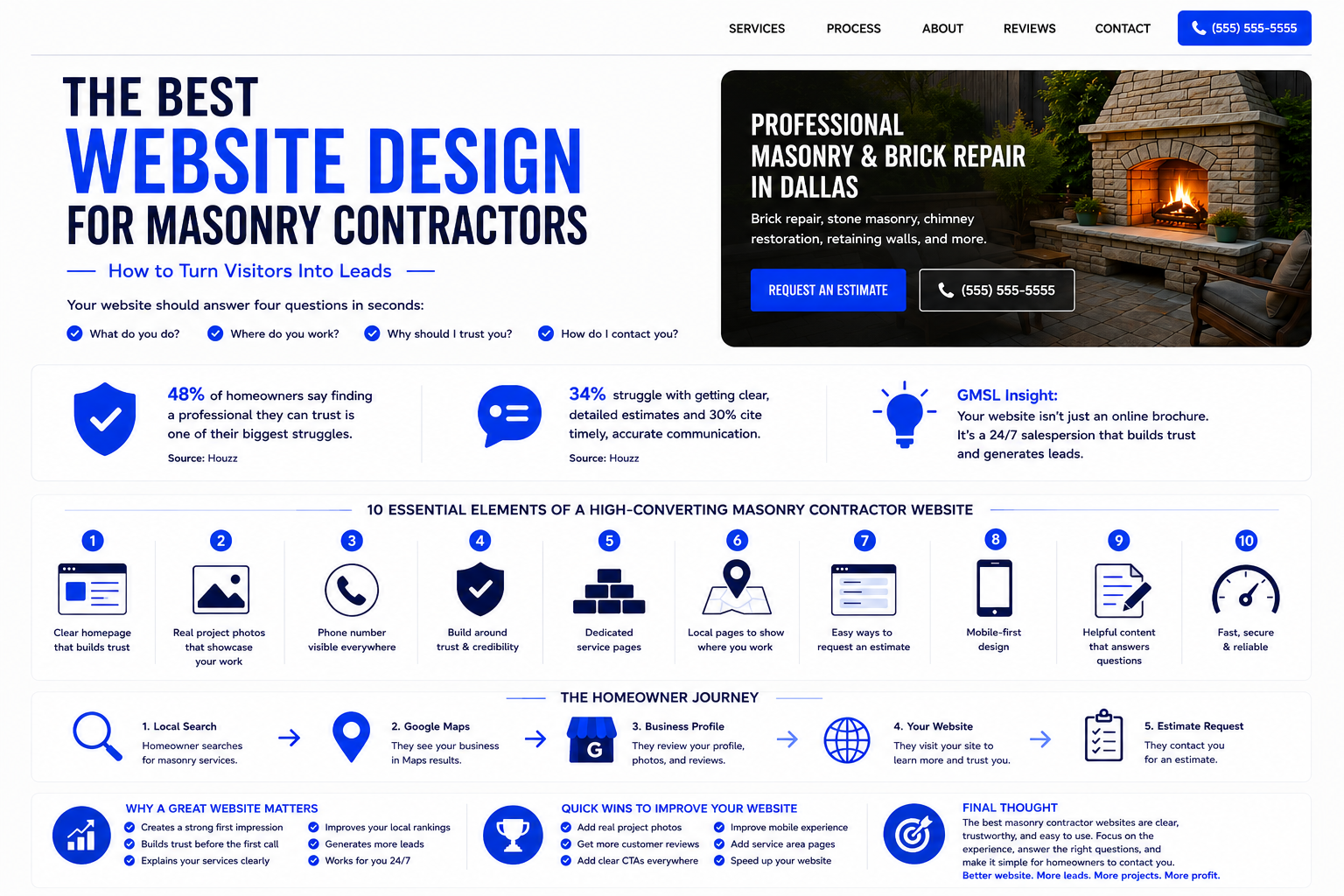
From our experience, the strongest contractor websites quickly answer four questions:
- What do you do?
- Where do you work?
- Why should I trust you?
- How do I contact you?
There is a lot you can do to improve your local presence and increase website conversions.
Based on what we have seen, the most successful masonry companies are not always the ones with the biggest websites or the largest marketing budgets. They are usually the ones that pay attention to how homeowners behave on their website and use that information to make better decisions.
They track what people click, which pages generate calls, where visitors leave, which forms get completed, and which services attract the most interest.
That data helps them improve their website with more confidence instead of guessing.
Today, we will review 25 ways to improve your masonry contractor website, strengthen your local presence, and turn more visitors into calls, estimate requests, and booked projects.
We know 25 improvements can feel like a lot. You do not need to fix everything in one day. Start with the most important changes, improve little by little, stay consistent, and keep building a website that works harder for your business.
Masonry Contractor Website Design: 25 Best Practices
A masonry contractor website should do more than look professional.
It should help homeowners understand what you do, see the quality of your work, trust your company, and take the next step. A strong website can work like a 24 hour salesperson for your masonry business. While your team is repairing brick, rebuilding chimneys, restoring stonework, or meeting customers, your website can show projects, explain services, answer questions, build credibility, and generate estimate requests.
For masonry contractors, the goal is simple.
Your website should turn more visitors into phone calls, estimate requests, and booked projects.
Make the Homepage Immediately Clear
When someone lands on your website, they should understand what your company does within a few seconds.
A common mistake is using a homepage headline that sounds professional but says almost nothing. Phrases like Quality You Can Trust or Building Excellence Since 1998 may sound fine, but they do not tell the homeowner what service you provide, where you work, or why they should contact you.
A stronger headline is specific.
Professional Masonry and Brick Repair in Dallas
That tells the visitor what you do and where you do it. Then your supporting text can quickly explain your main services, such as brick repair, tuckpointing, chimney restoration, stone masonry, retaining walls, patios, and walkways.
The homepage should quickly answer three questions.
- What do you do?
- Where do you work?
- How can someone contact you?
Open your homepage on your phone and give yourself five seconds. If you cannot immediately understand the service, location, and next step, the page needs to be clearer.
Show Real Masonry Work Above the Fold
Masonry is visual. Homeowners want to see the quality of your work before they call.
That is why real project photos should appear near the top of the website. A visitor should not have to scroll through half the page before seeing actual brickwork, stonework, chimney repairs, retaining walls, patios, or restoration projects completed by your company.
Stock photos can make a site look clean, but they usually do not build much trust. They show what masonry looks like in general. Real project photos show what your company can actually build, repair, or restore.
Good above the fold images can include a restored brick home, rebuilt chimney, stone entrance, masonry patio, retaining wall, or before and after repair.
A strong photo helps the visitor think: This company has done work like mine before.
That is the kind of trust your website should build immediately.
Put the Phone Number Where People Can See It
Do not hide your phone number on the Contact page.
Many homeowners prefer to call, especially when the issue feels urgent. A cracked chimney, damaged brick, leaning wall, missing mortar, or water penetration problem may push someone to contact a contractor quickly.
Your phone number should be visible in the header, easy to tap on mobile, and repeated near important calls to action. The visitor should never have to search for a way to reach you.
Use simple actions like Call Now, Request an Estimate, or Talk to a Masonry Contractor.
On mobile, make sure the phone number is clickable. A homeowner should be able to tap once and call.
Do not only design for people who carefully read every page. Design for busy homeowners who are comparing multiple contractors and want an easy next step.
Build Around Trust
Masonry work can be expensive, technical, and highly visible.
Homeowners may be worried about cost, quality, structural issues, water damage, matching existing brick, or hiring the wrong contractor. Your website should reduce that uncertainty before the first phone call.
Trust is built with proof.
- Google reviews
- Real project photos
- Before and after examples
- Years in business
- Licensing and insurance where applicable
- Certifications
- Warranty information
- Team photos
- Local project experience
Do not only say that your company is experienced. Show the evidence.
A strong masonry website makes the homeowner feel like they are dealing with a real local company, not a random website.
Trust sections should not be hidden at the bottom of the page. Reviews, photos, credentials, and proof should appear throughout the website, especially near calls to action.
Create a Strong Project Gallery
For masonry contractors, the project gallery can be one of the most valuable parts of the website.
But it should not be a random pile of photos.
Organize the gallery by the type of work homeowners care about. Someone interested in chimney repair should not have to scroll through patios, stone walls, and walkways before finding chimney examples.
Create simple sections for brick repair, stone masonry, chimney restoration, retaining walls, patios, walkways, and restoration projects.
For each section, show clean photos that clearly display the finished work. When possible, include a short caption explaining what was done.
Brick wall repair with matched replacement brick and repointed mortar joints.
That kind of detail helps the photo become more than decoration. It becomes sales proof.
Use Before and After Photos
Before and after photos are especially powerful for masonry contractors.
They make the value of your work obvious. A homeowner can quickly see the damaged brick, cracked mortar, deteriorated chimney, leaning wall, worn stonework, or broken steps before the job.
Then they see the repaired, restored, or rebuilt result.
This creates a clear transformation.
Before and after photos are useful because they do not require the visitor to understand every technical detail. They can see the improvement with their own eyes.
Use before and after photos on service pages, project pages, gallery pages, and even the homepage.
Many masonry contractors already have enough proof for a strong website. The problem is usually that the best photos are scattered across phones, old Facebook posts, Google Business Profile photos, text messages, and project folders. Organizing that proof can make the business look much more professional online.
Create Individual Service Pages
One of the biggest contractor website mistakes is putting every service on one page.
If a service can bring in profitable jobs, it should usually have its own page.
For masonry contractors, that could include brick repair, tuckpointing, chimney repair, stone masonry, retaining walls, patios, walkways, outdoor fireplaces, foundation masonry repair, and masonry restoration.
Each service page should explain what the service is, what problems it solves, when homeowners need it, what your process looks like, and how someone can request an estimate.
This is better for homeowners because the page feels more relevant.
It is also better for SEO because Google can understand each service more clearly.
A page about chimney repair can focus on chimney problems. A page about tuckpointing can focus on mortar repair. A page about stone masonry can focus on walls, veneers, fireplaces, and outdoor features.
Design Service Pages Around Customer Problems
A service page should not read like a technical encyclopedia.
Most homeowners are not searching because they want a textbook explanation. They are searching because they have a problem.
Someone looking for brick repair may be worried about cracked bricks, missing mortar, water damage, bulging walls, loose brick, matching replacement brick, or structural concerns.
Someone looking for chimney repair may be worried about leaks, cracks, missing mortar, leaning chimneys, damaged crowns, or safety issues.
Your service page should make the visitor feel understood.
A strong page makes them think: They understand exactly what I am dealing with.
After that, explain your solution, show relevant photos, answer common questions, and give them a clear way to contact you.
Build Strong Location Pages
If your masonry company serves multiple cities, your website should make that clear.
Location pages can help homeowners find your company when they search for masonry services in their area.
But weak location pages do not help much. A page where only the city name changes can feel thin and generic.
A stronger location page should include useful local information, services offered in that area, nearby project examples, photos, testimonials, common masonry problems, and frequently asked questions.
For example, instead of only saying Masonry Contractor in Plano, the page can mention brick repair, chimney restoration, stonework, retaining walls, and real projects completed nearby.
Real local proof is stronger than copied city pages. A photo from an actual project in that area can make the page feel more believable and useful.
Create Individual Project Pages
Your best jobs should become project pages.
A project page is more powerful than a basic gallery image because it tells the story behind the work.
A good project page can include the location, the problem, the service provided, the materials used, before photos, progress photos, after photos, and the final result.
A homeowner had deteriorated mortar and damaged brick on an older home. The contractor removed failing mortar, replaced damaged brick, matched the existing material, and repointed the affected sections. The result was a cleaner, stronger exterior that kept the original appearance of the home.
That kind of project page helps homeowners understand how you solve real problems.
It also gives your website more useful content for SEO.
Make Reviews Part of the Website
Do not hide every review on one testimonial page.
Reviews should appear throughout the website where they support the visitor's decision.
- A brick repair review belongs on the brick repair page.
- A chimney repair review belongs on the chimney page.
- A local customer review belongs on a location page.
- A strong review can appear near an estimate button.
Relevant reviews are more persuasive because they match what the homeowner is already considering.
Instead of only saying your company does great work, let real customers support the claim.
Show the People Behind the Company
Homeowners are not hiring a website.
They are hiring people.
Show real photos of the owner, crew, estimators, project managers, and team at work. Explain how the company started, what type of masonry work you specialize in, and what standards your team follows.
This helps the business feel real and local.
Many contractor websites feel anonymous. They use stock photos, generic copy, and no team information. That can make homeowners hesitate.
Showing the people behind the company creates familiarity before the first call.
A simple photo of the owner or crew can build more trust than another generic paragraph about quality workmanship.
Explain Your Process
Many homeowners do not know what happens after they request an estimate.
A clear process reduces uncertainty.
- Request an Estimate
- Project Evaluation
- Clear Proposal
- Schedule the Work
- Complete the Masonry
- Final Review
Each step only needs a short explanation. The goal is not to overcomplicate the page. The goal is to help the homeowner understand what happens next.
This is especially important for masonry work because some projects involve inspections, matching materials, structural concerns, weather timing, or multiple stages.
Clarity builds confidence.
Make Estimate Requests Easy
Do not make your contact form feel like a loan application.
The form should collect enough information to start the conversation, but not so much that people quit.
- Name
- Phone number
- ZIP code
- Service needed
- Short project description
For masonry projects, photo uploads can also be helpful. A homeowner can show cracked brick, chimney damage, deteriorated mortar, leaning walls, or stonework problems before the first conversation.
The form should work well on mobile. It should be simple, readable, and easy to complete.
Every extra required field can reduce the number of people who finish the form. Only ask for what you actually need.
Design Mobile First
Many homeowners will visit your website from a phone.
Your mobile website should be easy to read, easy to navigate, and easy to contact from.
Visitors should be able to tap the phone number, view project photos, read reviews, browse services, and request an estimate without frustration.
Mobile design is not just about making the desktop site smaller. It is about making the most important actions easy on a small screen.
The phone number should be easy to tap. Buttons should be large enough. Forms should be simple. Photos should load quickly. Text should not feel cramped.
A website that looks good on desktop but feels difficult on mobile can lose leads.
Make the Website Fast
Masonry websites often use many project photos.
That is good for trust, but large images can slow the website down if they are not optimized.
Slow pages can frustrate visitors and reduce conversions.
Compress images, use proper image sizes, avoid unnecessary scripts, remove heavy animations, and do not use oversized media where it is not needed.
You do not need to sacrifice beautiful photography.
You need to deliver it efficiently.
The goal is not just a fast score. The goal is a website that feels fast to a real homeowner on a real phone.
Do Not Overdesign the Website
A masonry website should feel solid, professional, local, and easy to use.
It does not need complicated animations, moving backgrounds, fancy effects, or confusing layouts to generate leads.
Design should support the visitor's decision.
Does this make it easier for the homeowner to choose us?
If the answer is no, keep it simple.
Good masonry website design should highlight services, photos, reviews, locations, calls to action, and trust signals.
It should not distract from them.
Use Calls to Action Throughout the Site
Do not assume visitors will scroll back to the top when they are ready to contact you.
Place calls to action naturally throughout the site.
- Request Your Masonry Estimate
- Need Brick Repair? Talk to Our Team
- Have a Similar Project? Request an Estimate
- Ready to Discuss Your Masonry Project?
The call to action should match the section. On a chimney page, mention chimney repair. On a brick repair page, mention brick repair. On a project page, invite visitors to request an estimate for a similar project.
A good CTA feels like the next logical step, not a random sales pitch.
Answer Common Questions
FAQs can remove hesitation before the homeowner contacts you.
Answer the questions people are already wondering about.
- How much does masonry repair cost?
- Can damaged bricks be replaced?
- Can you match existing brick?
- What causes mortar to deteriorate?
- How long does tuckpointing last?
- Do you repair chimneys?
- What areas do you serve?
- Are estimates free?
- How soon can work begin?
Good FAQs make the homeowner feel more informed. They also help your website cover the real questions people search before hiring a contractor.
Connect Your Website to Google Business Profile
Your website and Google Business Profile should support each other.
A homeowner may discover your company through Google Maps, read your reviews, look at your photos, and then click to your website.
The website should reinforce what they already saw.
That means the same services, the same service areas, strong reviews, real project photos, and a clear way to contact you.
Google Business Profile → Website → Reviews → Projects → Contact
Google Business Profile gets attention.
Your website helps turn that attention into a lead.
Build the Website for SEO From the Beginning
SEO should not be added after the website is finished.
The structure should be planned from the beginning.
A strong masonry website should have a clear homepage, individual service pages, location pages, project pages, an about page, a contact page, and helpful resources.
This helps Google understand what your company does and where you do it.
It also helps homeowners find the right information faster.
Someone searching for chimney repair should land on a chimney repair page, not a generic services page with one small paragraph about chimneys.
A clear structure helps both search engines and customers.
Build the Website Around the Projects You Want
Your website influences the type of customer who contacts you.
If you want more stone masonry projects, show more stonework.
If you want more historic restoration jobs, show restoration work.
If you want more chimney repair jobs, build a strong chimney repair section.
If you want larger outdoor living projects, show patios, walkways, retaining walls, fireplaces, and outdoor stonework.
The website should not only reflect the work you have done. It should help attract more of the work you want.
A contractor website should guide demand. The projects you feature, the pages you build, and the calls to action you use can shape the type of leads you receive.
Track What the Website Produces
Do not judge your website only by how it looks.
Judge it by what it produces.
Track phone calls, form submissions, qualified leads, estimates, booked jobs, and revenue.
A website can look beautiful and still produce very few leads. Another website can look simple but generate consistent calls and estimate requests.
The goal is not compliments.
The goal is business results.
You should know which pages bring leads, which services get attention, which traffic sources convert, and which forms or calls turn into real customers.
Track leads beyond the first form submission. A form is not the final result. The real question is whether that lead became an estimate and whether that estimate became revenue.
Think About Website ROI
A website should be evaluated by the value it can create, not only by what it costs.
A cheap website that never generates a customer can be expensive.
A larger investment that consistently helps produce profitable masonry projects can be inexpensive compared to the return.
Think less about:
How cheap can I get a website?
Think more about:
What return can this website create for my business?
For contractors, one good project can sometimes pay for a large part of the website. The real question is whether the website helps generate more qualified opportunities over time.
Keep Improving the Website Over Time
A contractor website should not be treated as a one time project that never changes.
Your best photos will improve. Your reviews will grow. Your services may change. Your service areas may expand. Your team may complete better projects.
Your website should be updated with new project photos, better service pages, fresh reviews, improved FAQs, stronger calls to action, and better tracking.
A strong website keeps getting better as the business grows.
The best contractor websites are not just launched. They are improved over time based on real leads, real projects, and real customer behavior.
📊 Click the diagram to view a larger version. After opening it, turn your phone sideways for the best viewing experience.
Real Life Website Example
Two masonry contractors can get the same amount of website traffic and still produce very different results.
The difference is not always traffic. Sometimes the difference is how well the website turns visitors into calls, estimate requests, and booked jobs.
Basic Website
Contractor A has a basic website.
The homepage uses a generic headline. The phone number is not easy to find. Most photos are stock images. All services are placed on one page. There are few reviews, no project pages, weak mobile design, and a long contact form.
The website may look acceptable, but it does not give homeowners enough reasons to take action.
Conversion Focused Website
Contractor B has a website built around real masonry projects, clear service pages, before and after photos, strong reviews, local project pages, click to call buttons, simple forms, and better mobile design.
The website makes it easier for homeowners to understand the service, trust the company, and request an estimate.
The traffic did not increase.
The second website simply did a better job of turning visitors into real opportunities.
This is why masonry contractor website design matters. A better website does not only make the company look more professional. It can help the same traffic produce more calls, more estimate requests, and more booked projects.
More traffic is valuable, but better conversion can create growth faster. Before spending more money on ads or SEO, make sure the website is built to turn visitors into qualified leads.
The Ideal Masonry Contractor Homepage
A strong masonry contractor homepage should be simple, clear, visual, and built around trust.
It does not need to be complicated. It needs to help homeowners quickly understand the company, see proof, and take action.
Hero
Main service, service area, real project photo, phone number, and estimate button.
Trust Signals
Reviews, years in business, credentials, warranties, or completed project counts.
Main Services
Brick repair, chimney repair, tuckpointing, stone masonry, retaining walls, patios, walkways, and restoration work.
Before and After
Show clear visual transformations from real masonry projects.
Project Examples
Feature real completed work that proves the quality of your company.
Customer Reviews
Add relevant reviews throughout the homepage to reinforce trust.
Service Areas
Clearly explain where your masonry company works.
Your Process
Explain what happens from the first estimate request through project completion.
FAQs
Answer common homeowner questions and remove hesitation.
Final Call to Action
Give homeowners one clear way to request their masonry estimate.
Common Masonry Website Design Mistakes
Many masonry contractor websites lose leads because they make the visitor work too hard.
A beautiful website is valuable.
But a beautiful website that generates profitable customers is much more valuable.
Frequently Asked Questions
What should a masonry contractor website include?
At minimum, include your services, service areas, real project photos, reviews, company information, phone number, contact form, trust signals, and clear calls to action.
How much does a masonry contractor website cost?
There is no universal price. Cost depends on the number of pages, custom design, SEO, content, photography, integrations, tracking, and complexity. Evaluate the website based on expected business value rather than price alone.
Should masonry contractors use real photos?
Yes. Real project photography demonstrates actual experience and helps customers evaluate your workmanship.
Does a masonry contractor need separate service pages?
Important services usually deserve dedicated pages. Brick repair, chimney repair, tuckpointing, stonework, and retaining walls can represent different customer needs and search intent.
Should masonry contractors have location pages?
Location pages can help communicate where you operate and support Local SEO when they contain useful, original information about markets you genuinely serve.
Should I put pricing on my masonry website?
It depends on your business and services. Pricing ranges can sometimes help qualify leads, but masonry costs vary substantially based on damage, access, materials, scope, and project complexity.
How many project photos should I show?
There is no magic number. Prioritize quality, variety, and relevance. A smaller collection of well-organized real projects can be more useful than hundreds of unexplained photos.
How do I know whether my website is working?
Track Visitors → Leads → Qualified Leads → Estimates → Customers → Revenue. Do not judge success based only on traffic or appearance.
Should I redesign an old masonry website?
If the site is difficult to use, slow, outdated, does not represent your current work, performs poorly on mobile, or fails to generate qualified leads, a redesign or substantial improvement may make sense.
Final Thoughts
The best website design for a masonry contractor is not the one with the most features.
It is the one that makes choosing your company easier.
A homeowner arrives with uncertainty. They want to know whether you can solve the problem, whether you have done it before, whether you work in their area, whether they can trust you, and how to get an estimate.
Answer those questions with evidence.
Show the brickwork. Show the stonework. Show the transformations. Show the reviews. Show the people behind the company. Explain the process. Then make contacting you incredibly easy.
Do not build a website simply because every business needs one. Build a digital salesperson that shows your craftsmanship, earns trust, and helps turn local homeowners into profitable masonry projects.
Ready to Build a Masonry Website That Generates More Leads?
GiveMeSomeLeads helps masonry contractors build conversion-focused websites with strong service pages, Local SEO, real project content, clear calls to action, mobile-friendly design, and measurable lead tracking.
- Conversion-focused masonry website strategy
- Service pages, project pages, and Local SEO
- Lead, estimate, customer, and revenue tracking