
A homeowner searches masonry contractor near me.
Three companies appear. One has 18 reviews. Another has 47. The third has 186 reviews, dozens of recent customer experiences, photos of completed masonry work, and thoughtful responses from the owner.
Review count is not everything, and the contractor with the most reviews is not automatically the best contractor.
But reviews provide something extremely valuable:
Evidence.
They show potential customers that real people have hired your company, trusted you with their property, and were willing to publicly describe the experience.
In this guide, we will review 24 ways to help masonry contractors get more Google reviews.
Based on what we see with contractors, the key is to stay authentic, make the process simple, and ask consistently after each completed project. Most customers will not leave a review just because they are happy. They need an easy next step, a direct review link, and sometimes one polite automatic reminder.
The challenge is that many excellent masonry contractors do not have a review problem. They have a review process problem. They do good work, finish strong projects, and leave customers satisfied, but they do not make it obvious or easy for those customers to share their experience online.
By asking at the right time, using simple reminders, placing review opportunities in the right places, and staying consistent, masonry companies can accumulate more real reviews over time. You do not need to force it. Build the process, keep it honest, and let time speak for the quality of your work.
How Masonry Contractors Can Get More Google Reviews: 24 Practical Ways
Google reviews can make a major difference for masonry contractors.
Masonry is built on trust. A homeowner may be hiring you to repair deteriorated brick, rebuild a chimney, repoint an older home, install stone veneer, build a retaining wall, or restore historic masonry. These are not small impulse purchases. Many homeowners cannot fully judge masonry craftsmanship before hiring, so they look for proof from previous customers.
That proof often comes from Google reviews.
A strong review profile can help homeowners feel more confident before they call. It can also support your local presence because reviews are part of how people compare contractors in Google Maps and local search results.
The goal is not to chase fake reviews or beg every customer.
The goal is to build a simple, honest review process that happens consistently after good work.
Understand Why Google Reviews Matter
Google reviews are not only about star ratings.
They help homeowners answer important questions before contacting you.
- Can this company be trusted?
- Do they communicate well?
- Do they show up when promised?
- Do they clean up after the job?
- Do past customers seem happy with the work?
For masonry contractors, this matters because the work is often expensive, technical, and highly visible. A homeowner wants to know that the company they hire can protect the property, explain the work clearly, and deliver a strong finished result.
A good review can reduce hesitation before the first call.
Use Reviews to Strengthen Google Maps Visibility
Reviews can also support your Google Maps presence.
When someone searches for a masonry contractor, brick repair company, chimney repair contractor, or tuckpointing service, they often compare businesses directly inside Google Maps.
A strong review profile can help your company look more established.
It can improve trust before the homeowner even visits your website.
Google reviews are one of the few marketing assets that can help before and after the click. They can influence whether someone clicks your profile, and they can influence whether they contact you after reading more.
Do Remarkable Work First
No review system can fix a bad customer experience.
Before asking for more Google reviews, the company has to deliver work worth reviewing.
That includes more than craftsmanship.
- Show up on time
- Return calls
- Protect the property
- Keep the site organized
- Communicate delays
- Clean up properly
- Explain the work
- Deliver what was promised
A homeowner may not understand every technical detail of tuckpointing or chimney restoration, but they understand whether your crew was respectful, organized, professional, and easy to deal with.
Great reviews usually start before the review request. They start with the experience.
Actually Ask for the Review
Many contractors do good work but rarely ask for reviews.
They assume happy customers will leave a review on their own.
Some will.
Most will not.
A simple review request can make a big difference.
We are glad you are happy with the brickwork. Reviews really help other homeowners find our company. I can text you our Google review link if you would be willing to share your experience.
That is simple, respectful, and natural.
You are not pressuring the customer. You are making it easy for them to help.
Ask at the Right Moment
Timing matters.
Do not wait three months after the project is finished. By then, the customer may be busy, distracted, or less emotionally connected to the result.
For many masonry jobs, the best time to ask is during or shortly after the final walkthrough.
The customer has just seen the finished work. The result is fresh. If they are happy, that is the right moment to ask.
Make the review request part of closing the project.
Send a Direct Google Review Link
Do not make customers search for your company, find the profile, click reviews, and figure out where to leave feedback.
Send the direct review link.
The easier the process is, the more likely people are to complete it.
Save your Google review link somewhere your team can access quickly, such as your CRM, phone notes, email template, text template, invoice system, or project management software.
Use Text Messages
Text messages are one of the easiest ways to ask for a review because many contractors already communicate with homeowners by phone.
Keep the message short, personal, and specific to the project.
Hi John, thanks again for trusting us with your chimney repair. We are glad you are happy with the finished work. If you have a minute, we would really appreciate you sharing your experience on Google: [Review Link]
This works because it feels personal, not robotic.
It references the actual project and makes the next step easy.
The best review requests usually do not feel like campaigns. They feel like the natural final step after a good customer experience.
Use Email as a Second Opportunity
Not every customer responds to text.
Email gives you another simple way to ask.
A good review email should be short. Thank the customer, mention the project, explain why reviews matter, and include the direct link.
Do not write a long sales message.
The customer already hired you.
The goal is simply to make leaving feedback easy.
Email also works well when the project involved a larger scope, multiple decision makers, or a more formal customer relationship.
Use a QR Code
A QR code can make it easier for customers to reach your Google review page.
You can place it on:
- Completion paperwork
- Thank you cards
- Printed invoices
- Leave behind materials
- Project folders
A QR code is especially useful when you are with the customer in person. After the final walkthrough, they can scan it and leave a review while the finished work is still fresh.
Use the QR code where it fits naturally. Project completion is usually better than project introduction.
Get Your Team Involved
If only the owner cares about reviews, the process will eventually break.
A review system works better when the team understands the role they play.
This keeps the process simple and consistent.
If reviews matter to your growth, they need a process just like estimates, invoices, scheduling, and follow up.
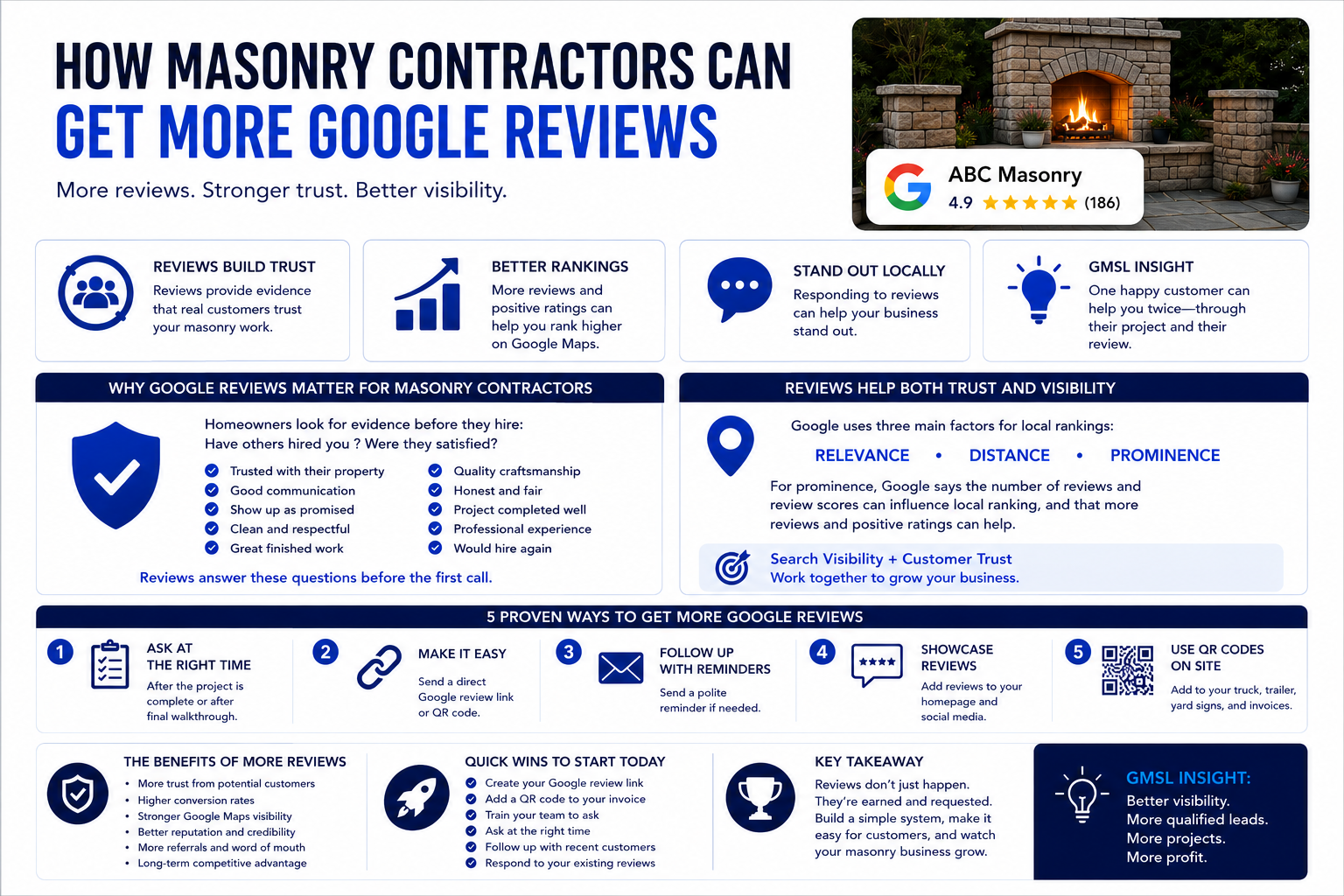
📊 Click the diagram to view a larger version. After opening it, turn your phone sideways for the best viewing experience.
Create a Great Experience Before the Project Ends
The review starts long before you ask for it.
A customer does not only review the finished mortar, brick, or stonework.
They review the entire experience.
Contractor A may do excellent masonry but communicate poorly, leave materials scattered, miss callbacks, and create scheduling confusion.
Contractor B may do equally strong masonry but also communicate clearly, protect the property, send updates, clean the site, and walk the customer through the finished work.
Both contractors may be skilled.
But Contractor B is more likely to earn a stronger review.
The customer reviews the experience, not just the mortar.
Give Customers Something Specific to Remember
Generic experiences create generic reviews.
Specific experiences create better reviews.
- Your crew protected expensive landscaping
- You matched difficult historic brick
- You explained why the chimney was deteriorating
- You sent progress photos while the homeowner was away
- You cleaned the property better than expected
- You finished ahead of schedule
Those details give customers something real to mention.
Great company.
They matched our old brick perfectly and left the yard spotless.
Do Not Tell Customers What to Write
You can ask for a review.
You should not script the review.
Let customers use their own words and describe their real experience.
That is what makes reviews believable.
A natural review from a real customer is more valuable than a review that sounds fake, forced, or overly polished.
Authenticity is what gives reviews their value.
Never Buy Google Reviews
Do not buy reviews.
Do not create fake customer accounts.
Do not ask employees to pretend they are customers.
Do not use services promising dozens of five star reviews.
Trust.
Real reviews take longer, but that is part of why they are valuable. A strong reputation is difficult for competitors to copy when it is built from real customer experiences.
Do Not Offer Rewards for Google Reviews
Do not offer gift cards, discounts, free services, or other rewards in exchange for Google reviews.
That can make the review process feel less honest.
The better approach is to earn reviews through a strong customer experience and a simple request process.
You want customers to leave reviews because they are genuinely satisfied, not because they were paid or rewarded.
Do Not Only Ask Customers You Think Will Give Five Stars
The goal should be authentic feedback, not engineered perfection.
Only asking customers you believe will leave five stars can make the review profile look less natural.
Instead, focus on creating better customer experiences and asking satisfied customers honestly for feedback.
A strong business should want to know what customers actually think.
That feedback can help improve the company.
Respond to Positive Reviews
Do not collect reviews and ignore them.
Respond to positive reviews in a natural way.
A good response should thank the customer and reference the project when appropriate.
Thanks, Michael. We appreciate you trusting our team with the chimney restoration. Matching the existing brick was an important part of that project, and we are glad you are happy with the result.
This response does two things.
It thanks the customer.
It also gives future homeowners more context about the type of work you do.
Respond Professionally to Negative Reviews
Most established businesses eventually receive criticism.
Do not panic.
Do not argue.
Do not respond emotionally.
If the criticism is legitimate, acknowledge the issue, explain appropriately, and try to resolve the situation.
Your response is not only for the reviewer. It is for every future homeowner who reads the exchange.
A calm, professional response can still build trust, even when the review is negative.
Turn Great Reviews Into Marketing Assets
A strong review should not only live on Google.
You can reuse genuine customer feedback throughout your marketing.
- Website
- Service pages
- Landing pages
- Project pages
- Social media
- Estimate follow up
- Sales materials
Match the review to the service whenever possible.
A chimney repair review belongs on the chimney repair page.
A brick repair review belongs on the brick repair page.
A retaining wall review belongs near retaining wall project photos.
This makes the proof more relevant.
Connect Reviews to Project Photos
Masonry contractors have a major advantage because the work is visual.
A review becomes much stronger when it is connected to the project.
Now the future homeowner can see the full story.
That combination is much stronger than a review or photo by itself.
Ask for Reviews Consistently
Consistency creates the compounding effect.
Imagine a masonry company completes 100 projects per year.
The exact percentages are only examples, but the principle matters.
You may not need more customers to build a stronger review profile.
You may need a better review request process.
The contractor with the strongest review profile is not always serving dramatically more customers. They may simply be asking more consistently after completed projects.
Track Review Requests
What gets tracked usually becomes more consistent.
Add simple tracking fields to your CRM, spreadsheet, or project management system.
- Project completed
- Customer satisfied
- Review request sent
- Follow up sent
- Review received
This helps you see whether the review process is actually happening.
Without tracking, reviews become random. With tracking, reviews become part of the business system.
Follow Up Once When Appropriate
Sometimes a customer intends to leave a review but forgets.
One friendly reminder can be appropriate.
Hi Sarah, just wanted to send our review link again in case the first message got buried. We really appreciate you choosing us for the brick restoration. Thanks again: [Review Link]
One reminder is reasonable.
Repeatedly asking is not.
Make it easy, not annoying.
Use Reviews to Improve the Business
Reviews are not only marketing.
They are customer research.
Look for patterns in what customers say.
Reviews tell you what customers notice.
Your reviews show what customers think your company is good at, not only what you think your company is good at.
Real Life Example: Two Masonry Companies
Two masonry companies can complete the same number of projects and still build very different online reputations.
The difference is not always the quality of the masonry.
Sometimes the difference is the review process.
No Review System
Company A completes 150 projects over three years.
The work is good, but reviews happen randomly. Sometimes the owner asks. Sometimes the office forgets. Sometimes happy customers leave reviews on their own, but there is no real system.
Simple Review System
Company B also completes 150 projects over three years.
After each completed project, the team confirms the customer is satisfied, asks personally, sends a direct Google review link, follows up once when appropriate, responds to the review, and reuses strong feedback on the website.
The number of projects did not change.
The craftsmanship may be similar.
The difference is that Company B has a repeatable process.
Same number of projects. Different review profile. Different level of trust online.
A stronger review system can help a masonry company look more established without needing more jobs first. The company may simply need to do a better job capturing proof from the customers it already serves.
The GMSL Review System for Masonry Contractors
A good review system does not need to be complicated.
It needs to be simple enough that the team actually follows it.
Deliver Great Work
Create an experience worth reviewing.
Complete the Final Walkthrough
Review the finished work with the customer and confirm they are satisfied.
Ask Personally
Make the request feel human, not automated.
Send the Direct Review Link
Remove unnecessary steps.
Follow Up Once
Send one polite reminder when appropriate.
Respond to the Review
Thank the customer and mention the project when relevant.
Reuse the Proof
Add strong reviews to your website, service pages, project pages, landing pages, and social content.
Track the Process
Make sure review requests happen after every completed project.
Common Google Review Mistakes Masonry Contractors Make
Many masonry contractors lose reviews because there is no process.
A strong review strategy is not complicated.
It is consistent.
Frequently Asked Questions
How can masonry contractors get more Google reviews?
Deliver a strong customer experience, ask customers directly, send a direct review link or QR code, make the process easy, and build the request into your project-completion workflow.
When is the best time to ask for a Google review?
For many masonry contractors, the final walkthrough is an excellent opportunity because the customer has just seen the finished work. The best timing depends on your project and customer experience.
Can Google reviews help my masonry company rank higher?
Reviews can support local visibility and customer trust, although they are only one part of a broader local search system.
Can I text customers a Google review link?
Yes. A direct review link can be shared through customer communications such as text or email.
Can I create a QR code for Google reviews?
Yes. A QR code can provide customers with another direct path to the review process and works well on completion paperwork or thank-you materials.
Can I offer customers a discount for leaving a review?
No. Do not offer discounts, gifts, or other rewards in exchange for reviews. Build reviews from genuine customer experiences.
Should I respond to every Google review?
Responding consistently is a strong practice. Public replies show that your company values customer feedback and give future homeowners another way to evaluate your professionalism.
Can I remove a bad Google review?
Reviews that violate platform policies can be reported, but disagreement with criticism alone is not a reason to expect removal. Respond professionally and focus on resolving legitimate concerns where possible.
How many Google reviews should a masonry contractor have?
There is no universal ideal. Compare your profile with established masonry competitors in the markets you serve while focusing on consistently earning genuine reviews rather than chasing an arbitrary target.
Final Thoughts
The best Google review strategy is not complicated.
Do excellent work. Create a great customer experience. Ask. Make reviewing you easy. Respond. Repeat.
The important part is consistency.
One completed chimney repair can generate revenue, but it can also produce a Google review, testimonial, before-and-after photos, case study, and more trust.
As simple as it sounds, reviews are free publicity. Ask for them as much as you can, as long as the request is honest and the customer had a good experience.
A single review can be read by homeowners who have never met you, never seen your crew, and never visited one of your job sites. That review can help them feel more comfortable requesting an estimate.
That is why a completed masonry project should not end when the invoice is paid.
It should leave your business with a stronger reputation than it had before the project began.
You already did the hardest part: earning a happy customer. Do not forget to give them an easy opportunity to tell the next homeowner about it.
Ready to Build a Stronger Review and Local SEO System?
GiveMeSomeLeads helps masonry contractors strengthen Google Business Profile performance, Local SEO, review generation, project content, websites, Google Ads, and lead tracking.
- Google review generation systems
- Google Business Profile and Local SEO
- Lead, estimate, customer, and revenue tracking