
Most roofing companies do not have a roofing problem.
They have a customer acquisition problem.
You can have excellent crews, strong workmanship, competitive pricing, and good warranties, but none of that matters if there are not enough qualified homeowners requesting estimates.
That is where roofing lead generation comes in.
From our experience with contractors, and even from building our own business, the strongest approach is to never rely on only one lead source. The goal is to build a complete customer acquisition system that becomes a long term asset for your company. Some channels will perform better than others at different times, but that does not mean the others should be ignored. Google Ads, SEO, Google Business Profile, reviews, referrals, project photos, landing pages, and follow up can all support each other. The more diversified your opportunities are, the less dependent your business becomes on one platform, one campaign, or one season. Over time, this gives your roofing company more stability, more control, and more chances to turn visibility into real customers.
What Is Roofing Lead Generation?
Roofing lead generation is the process of attracting homeowners or property managers who need roofing services and turning their interest into real conversations with your company.
A roofing lead might be someone who:
- Calls your office
- Fills out an estimate request form
- Sends your company a message
- Books a roof inspection
- Requests a roof replacement quote
- Responds to a Google Ad
- Is referred by a previous customer
However, a lead is only the beginning.
The real objective is not simply generating more leads. It is generating qualified roofing customers who become profitable projects.
A healthy roofing marketing system should follow this path:
Every marketing decision should move homeowners one step further through that process.
Why It Matters
Many roofing companies judge success by the number of leads they receive.
But 100 low quality leads that never become customers are far less valuable than 20 homeowners who actually need a new roof and are ready to move forward.
Quality almost always beats quantity.
According to Google, searches containing "near me" continue to grow as homeowners increasingly look for local service providers when they need immediate help. For roofing companies, this means being visible exactly when someone is actively searching for a contractor can create highly qualified opportunities.
Two roofing companies each generate 40 leads this month.
The first company receives mostly homeowners looking for small repairs outside its service area.
The second receives fewer inquiries, but most are complete roof replacements within its ideal cities.
Even with fewer leads, the second company produces more revenue because its marketing attracts the right customers.
Before spending another dollar on advertising, define what a successful roofing customer looks like. Your marketing should be designed to attract that customer, not everyone.
Many contractors focus on generating more leads when they should first focus on generating better leads. A marketing system that consistently brings qualified homeowners is far more valuable than one that simply produces a high volume of inquiries.
30 Proven Ways to Generate More Roofing Leads
There is no single strategy that consistently generates qualified roofing leads.
The most successful roofing companies build multiple lead generation channels that work together. Some strategies, like Google Ads, can generate opportunities almost immediately, while others, such as Local SEO and Google Business Profile optimization, continue producing leads for years when maintained properly.
The goal is not to rely on one source of leads. It is to build a complete marketing system that helps homeowners find your business, trust your company, contact you, and ultimately become long term customers.
Below are 30 proven roofing lead generation strategies that can help you generate more qualified leads, improve your online visibility, and build marketing assets that continue working for your business long after they are created.
1. Define the Roofing Leads You Actually Want
Before investing in marketing, decide exactly what type of roofing work you want to generate.
Ask yourself questions like:
Then define:
- Your ideal service area
- Minimum project size
- Average project value
- Target customer
- Available capacity
Your marketing should attract the jobs you actually want, not simply more work.
Why It Matters
Not every roofing lead has the same value.
If your company specializes in complete roof replacements, attracting dozens of small repair requests can waste time for both your office staff and your estimators.
The clearer your target, the more efficient your marketing becomes.
HubSpot has consistently found that businesses with a clearly defined ideal customer profile generate higher quality leads because their marketing is more focused and relevant to the audience they want to attract.
A roofing company spends thousands advertising "Roofing Services."
Another advertises specifically for residential roof replacements in its preferred service area.
The second company receives fewer inquiries, but most become profitable estimates because the marketing matches the work it actually wants.
Write down your ideal roofing customer before launching any campaign. Every advertisement, landing page, and service page should be built around attracting that customer.
One of the biggest mistakes contractors make is building marketing that keeps them busy doing work they do not enjoy or that is not profitable. Your marketing should help shape your business, not control it.
2. Google Ads for High Intent Roofing Leads
Google Search Ads are one of the fastest ways to appear in front of homeowners actively searching for roofing services.
Unlike many other marketing channels, these homeowners have already identified a need and are looking for a solution.
Why It Matters
Google Ads target existing demand.
Instead of convincing homeowners they might need roofing services someday, you are connecting with people who are already searching for a contractor.
That often produces some of the highest intent leads available.
Google reports that local searches frequently lead to action, with many users contacting or visiting a business shortly after searching. Roofing companies that appear during these high intent searches have the opportunity to capture homeowners at the exact moment they are ready to request an estimate.
A homeowner notices shingles missing after a severe storm.
Within minutes they search:
If your ad appears with strong reviews, a professional landing page, and a simple estimate form, your company has an opportunity to earn that customer before competitors even appear.
Never send paid traffic to your homepage. Every Google Ads campaign should direct visitors to a landing page built specifically for the service being advertised.
Google Ads can generate leads almost immediately, but the ad is only one piece of the system. High converting landing pages, accurate conversion tracking, fast follow up, and a strong sales process are what turn clicks into profitable roofing customers.
3. Use Negative Keywords
Google Ads can generate excellent roofing leads, but they can also waste a significant portion of your budget if your campaigns appear for the wrong searches.
Negative keywords tell Google when not to show your ads.
Regularly reviewing your Search Terms Report helps identify searches that bring clicks but are unlikely to become paying customers.
Why It Matters
Every irrelevant click costs money.
If someone searches for "roofing jobs near me" or "how to replace roof shingles yourself," they are probably not looking to hire a roofing contractor.
Filtering these searches allows more of your advertising budget to go toward homeowners who actually need your services.
Google recommends regularly reviewing search terms and using negative keywords to improve campaign relevance. Removing irrelevant searches can increase click quality and help reduce wasted ad spend.
A roofing company notices that many clicks are coming from searches like:
- Roofing jobs
- Roofing apprenticeship
- Roofing supplies
- DIY roof repair
None of these users become customers.
After adding these phrases as negative keywords, the company spends less on irrelevant traffic and focuses more of its budget on homeowners actively searching for roofing contractors.
Review your Search Terms Report every week, especially during the first few months of a campaign. Small adjustments made consistently can significantly improve lead quality over time.
One of the easiest ways to improve a Google Ads campaign is not increasing the budget. It is reducing wasted clicks. Spending the same amount on better qualified visitors almost always produces stronger long term results.
4. Build Dedicated Roofing Landing Pages
A homeowner searching for roof replacement should not land on your homepage. They should arrive on a page built specifically for roof replacement.
An effective roofing landing page should include:
- A clear headline
- The service being advertised
- Service areas
- Real project photos
- Before and after examples
- Customer reviews
- Warranty information
- Credentials
- Clear calls to action
- A simple estimate request form
Every element should help homeowners feel confident enough to contact your business.
Why It Matters
Even the best Google Ads campaign can struggle if visitors land on a confusing page.
Landing pages remove distractions and keep homeowners focused on one goal: requesting an estimate.
According to Unbounce's Conversion Benchmark Report, landing pages that maintain a clear focus and a single primary objective generally outperform pages with multiple competing calls to action.
Two roofing companies advertise roof replacement.
The first sends visitors to its homepage, where homeowners must search through menus to find the right service.
The second sends visitors directly to a roof replacement landing page with project photos, reviews, financing information, and a visible estimate form.
The second company creates a much smoother experience, making it easier for homeowners to take the next step.
Create separate landing pages for your highest value services instead of sending every visitor to the same page. Better message matching often leads to better conversion rates.
Buying more traffic is not always the answer. Sometimes the fastest way to generate more roofing leads is simply converting more of the visitors you are already paying for.
5. Invest in Local SEO
Google Ads can generate leads quickly.
Local SEO helps generate leads for years.
A strong Local SEO strategy includes:
- Google Business Profile
- Roofing service pages
- Location pages
- Google reviews
- Roofing project pages
- Helpful roofing content
- Local authority signals
Unlike paid advertising, Local SEO builds marketing assets that continue working long after they are created.
Why It Matters
Many homeowners search Google multiple times before contacting a roofing company.
They may compare Google Maps listings, read reviews, visit several websites, and research roofing questions before requesting an estimate.
A strong Local SEO presence helps your business appear throughout that decision process.
BrightLocal's Local Consumer Review Survey consistently shows that most consumers use the internet to find local businesses and regularly read online reviews before deciding who to contact. This makes Local SEO and reputation management two of the strongest long term investments for local service businesses.
One roofing company relies entirely on Google Ads.
Another invests in Google Ads while consistently improving its Google Business Profile, publishing roofing project pages, collecting reviews, and creating helpful roofing content.
After a year, the second company receives leads from both paid advertising and organic search, making its marketing more predictable and less dependent on advertising alone.
Think of every completed roofing project as future marketing content. A single job can generate reviews, project photos, social media posts, Google Business Profile updates, and SEO content.
Google Ads and Local SEO are not competitors. They complement each other. Google Ads generates immediate opportunities, while Local SEO builds long term visibility. The strongest roofing companies invest in both so they can generate leads today while strengthening their marketing for tomorrow.
6. Optimize Your Google Business Profile
For many homeowners, your Google Business Profile may be one of the first places they evaluate your roofing company.
They can quickly see your reviews, rating, photos, phone number, website, services, hours, and service area. If your profile looks incomplete, outdated, or inactive, you may lose the lead before the homeowner ever visits your website.
Keep your profile accurate and active with:
- Business hours
- Correct phone number
- Website link
- Roofing services
- Service areas
- Real project photos
- Recent reviews
- Professional business description
Your Google Business Profile should make it easy for homeowners to understand what you do, where you work, and why they should contact you.
Why It Matters
Roofing is a high trust service. A homeowner may be comparing several companies at the same time, and your profile needs to build confidence quickly.
A complete profile does more than help visibility. It helps homeowners decide whether your company looks legitimate enough to call.
BrightLocal’s 2026 Local Consumer Review Survey found that 71 percent of consumers use Google to read local business reviews. That makes your Google Business Profile one of the most important trust assets for a local roofing company.
A homeowner searches for roof replacement near them.
One roofing company has a profile with no recent photos, only a few reviews, and limited service information.
Another has recent roof replacement photos, a clear service area, strong reviews, and a website that matches the services on the profile.
The second company gives the homeowner more reasons to click, call, or request an estimate.
Look at your Google Business Profile from a homeowner’s perspective. Ask yourself whether the profile gives enough proof to make someone comfortable contacting your company.
Your Google Business Profile should not be treated as a one time setup. It should grow with your business. Every new roof, review, photo, and service update can strengthen your local presence over time. Your original draft highlights the profile as one of the homeowner’s first interactions with the company.
7. Build Strong Roofing Service Pages
Do not rely on one homepage to explain every roofing service.
If roof replacement, roof repair, metal roofing, flat roofing, storm damage, or commercial roofing are important to your business, each service should have a strong dedicated page.
A good roofing service page should explain:
- The problem the homeowner is facing
- The roofing service you provide
- When the service is needed
- Materials or systems used
- Your process
- Service areas
- Relevant project photos
- Reviews or testimonials
- Frequently asked questions
- The next step to request an estimate
Why It Matters
Different roofing services have different customer intent.
Someone searching for emergency roof repair is in a different mindset than someone comparing metal roofing options. A commercial property manager looking for flat roofing also has different questions than a homeowner replacing asphalt shingles.
Dedicated service pages help you speak directly to each type of customer.
A homeowner searches for metal roofing options.
If your website only has a general roofing page with one sentence about metal roofs, the homeowner may not feel confident that you specialize in that service.
But if you have a dedicated metal roofing page with benefits, materials, photos, FAQs, service areas, and a clear estimate CTA, the page feels much more relevant.
Start with the services that bring your best customers. You do not need to build every service page at once. Build the pages that support your most profitable work first.
If a roofing service is important enough to deserve marketing dollars, it is important enough to deserve a strong page. Your original section already points toward dedicated service pages for roof replacement, roof repair, metal roofing, commercial roofing, flat roofing, storm damage, and emergency roofing.
8. Create Location Pages
If your roofing company serves several valuable cities, build useful location pages.
A location page should not be a copied page with only the city name changed. It should help homeowners in that market understand that you actually serve their area and have experience with local roofing needs.
A strong location page can include:
- Nearby roofing projects
- Local homeowner testimonials
- Neighborhoods or areas served
- Common roofing concerns in that market
- Roofing services offered in that city
- Original project photos
- Clear estimate request CTA
Why It Matters
Homeowners often want to know whether you work in their area.
A useful location page helps answer that question while also supporting your local SEO strategy. It connects your roofing services to the specific markets where you want more work.
A roofing company creates 20 city pages with almost the exact same content.
Those pages feel generic.
Another company creates fewer location pages, but each one includes real projects, photos, testimonials, and useful local details.
The second approach builds more trust because the pages feel connected to real business activity.
Do not build location pages for every city you might possibly serve. Build them for the cities where you want more roofing jobs and can show real local relevance.
Location pages should help homeowners, not just search engines. The goal is to make your roofing company look active, credible, and relevant in the markets that matter most. Your original draft warns not to duplicate one page dozens of times and recommends using genuine local information.
9. Get More Google Reviews
Roofing is a high trust service, and reviews can heavily influence whether a homeowner contacts you.
Do not wait for reviews to happen randomly. Build review requests into the project completion process.
The best time to ask is when the homeowner is happy with the finished roof and the experience is still fresh.
Why It Matters
Homeowners are often comparing multiple roofing companies before making a decision. Reviews help them understand more than your rating. They show how your company communicates, handles problems, cleans up, explains the work, and delivers the final result.
Recent, detailed reviews can make your business feel safer to contact.
BrightLocal’s 2026 Local Consumer Review Survey found that 2 in 5 consumers read reviews every time they look for a business. The same research also says consumers increasingly expect higher star ratings and fresh reviews.
Two roofing companies complete the same number of roofs every year.
The first rarely asks for reviews and ends up with only a few new ones.
The second asks every satisfied customer after the final inspection and sends a direct review link.
After one year, the second company has much stronger visible proof, even if both companies do quality work.
Ask while the customer is still excited about the finished result. Waiting too long reduces the chance that they will leave a review.
Reviews turn completed roofing projects into public proof. A strong review process helps every happy customer strengthen your future marketing. Your source section already recommends making review requests part of project completion.
10. Turn Every Roof Into Marketing Content
One completed roof can create content for weeks or even months.
The mistake many roofing companies make is finishing the job, collecting payment, and moving on without documenting the work. But every project can strengthen your website, Google Business Profile, social media, sales process, and future advertising.
Capture useful material such as:
- Before photos
- Tear off photos
- Decking condition
- Underlayment
- Installation progress
- Flashing details
- Finished roof photos
- Drone shots where appropriate
- Homeowner testimonial
Then reuse that material across your marketing.
Why It Matters
Roofing is visual. Homeowners want to see proof of real work before trusting a contractor with a major project.
Real project content helps you show experience instead of only claiming it. It also gives you original material that competitors cannot copy.
Google has reported that businesses with photos on their Business Profiles receive 42 percent more requests for directions and 35 percent more website clicks than businesses without photos. For roofers, this reinforces how important real project photography can be in local search.
A roofing crew completes a full replacement but takes only one final photo.
That photo helps a little.
Another crew captures the old roof, tear off, damaged decking, installation progress, flashing details, final result, and homeowner feedback.
That one project can now become a project page, Google profile update, social post, ad creative, and sales proof.
Create a simple photo checklist for every job. The easier you make documentation for your team, the more consistently it will happen.
Many roofers do not lack marketing content. They lack a documentation process. Every completed roof should become proof that helps generate the next opportunity. Your original draft makes this exact point by showing how one roof can be reused across multiple marketing channels.
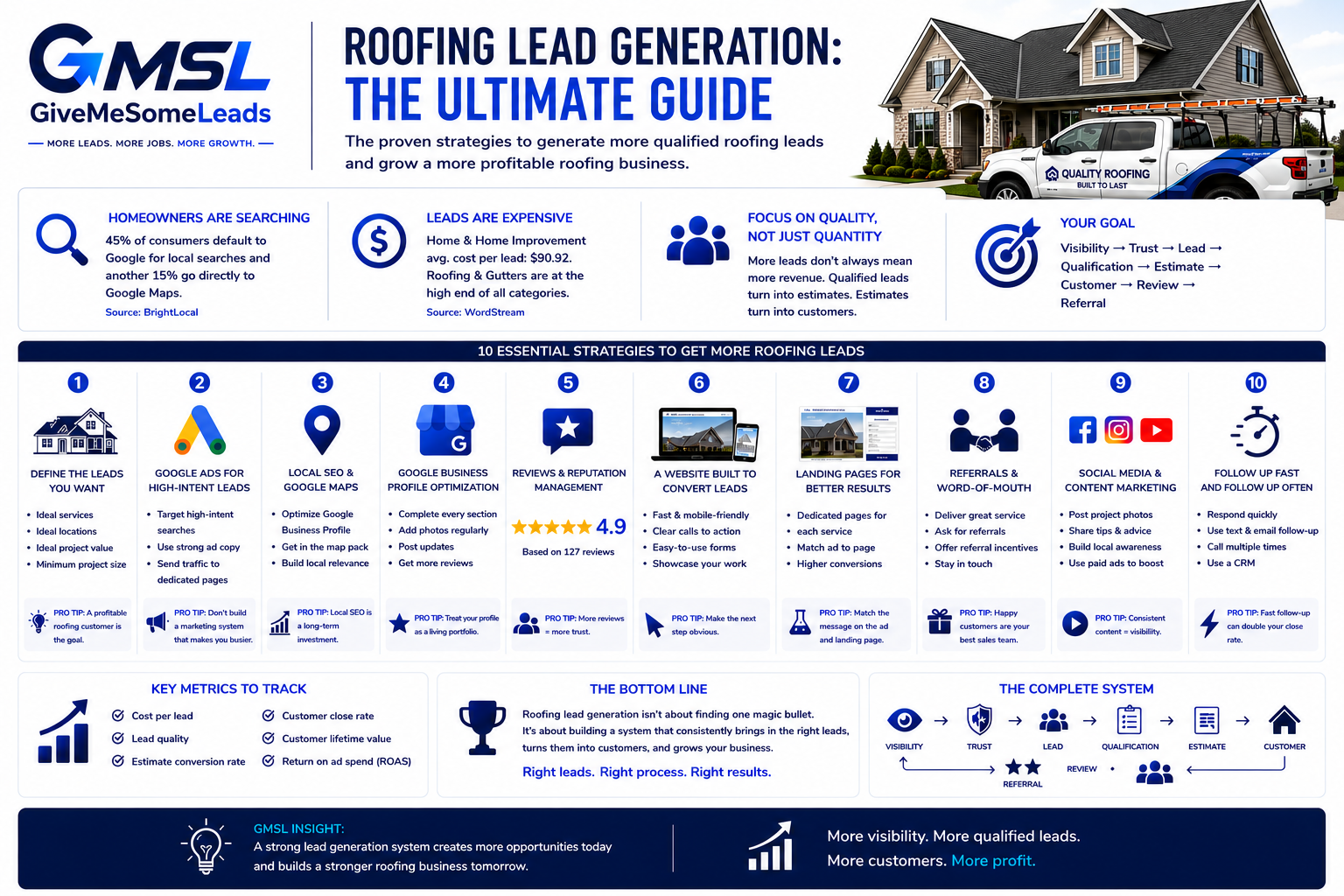
📊 Click the diagram to view a larger version. After opening it, turn your phone sideways for the best viewing experience.
11. Build Roofing Project Pages
Instead of placing every photo into one large gallery, turn your strongest roofing projects into individual project pages.
Complete Roof Replacement in Tampa
The Problem: Aging shingles and recurring leaks
The Work: Removed the existing roof, repaired decking where needed, installed the new roofing system, and upgraded flashing
The Result: A finished roof with before photos, installation photos, final photos, and a customer review
This gives homeowners proof that your company has completed real work in real locations.
Why It Matters
Project pages help your roofing company show experience instead of just claiming it.
They also support Local SEO because each page can connect a service, location, project type, photos, and customer proof together.
A homeowner searches for roof replacement in Tampa.
They find a project page showing a completed roof replacement in a nearby neighborhood with photos, a description of the problem, and the final result.
That page feels more trustworthy than a generic service page because it shows real work completed for a real customer.
Every roofing project can become a marketing asset. A good project page can strengthen your website, support SEO, improve trust, and give future customers more confidence before they contact you.
12. Use Facebook and Instagram
Facebook and Instagram can work well for roofing when the content is visual and easy to understand.
- Before and after roof photos
- Storm damage examples
- Drone footage
- Installation videos
- Customer testimonials
- Educational clips
- Crew footage
Google captures homeowners who are already searching. Social media can help introduce your company before someone actively looks for a roofer.
Why It Matters
Not every homeowner is ready to search for a roofing contractor today.
But they may notice your work, recognize your brand, save your post, or remember your company later when they need a roof repair or replacement.
Social media helps create familiarity before the buying moment.
A homeowner sees your company posting roof replacement photos in their area.
They do not need a roofer immediately, but a few months later they notice roof damage after a storm.
Because they have already seen your work online, your company feels more familiar when they start comparing contractors.
Keep social media simple. Post real projects, real crews, real transformations, and useful homeowner tips. You do not need complicated content to look professional and stay visible.
Social media should not replace Google Ads, SEO, or your website. It should support them by building familiarity, proof, and trust around the work your company is already doing.
13. Use Facebook Lead Ads Carefully
Facebook Lead Ads can generate volume, but volume and quality are not the same.
Because Facebook forms are easy to submit, some leads may be less serious than someone searching directly on Google. That does not mean Facebook Lead Ads cannot work. It means they need stronger filtering and faster follow up.
Use qualification questions such as:
Why It Matters
Cheap leads can become expensive if they waste your team’s time.
A campaign that generates many low quality inquiries may look good on paper, but if few people answer the phone or book estimates, the real cost per customer can be much higher than expected.
Campaign A generates 100 Facebook leads at a low cost, but only 5 become real estimates.
Campaign B generates fewer leads, but the form asks better questions and filters out people who are not ready.
Even with fewer leads, Campaign B may produce better customers because the system focuses on quality.
Do not judge Facebook Lead Ads by cost per lead alone. Track cost per qualified lead, cost per estimate, and cost per customer.
Do not optimize Facebook for the cheapest lead. Optimize the entire system for the cheapest profitable customer. That means better questions, fast follow up, accurate tracking, and a clear sales process.
14. Build a Referral System
Roofing referrals should not happen entirely by accident.
After a successful project, create a simple process:
- Ask for a review
- Ask for referrals
- Stay in touch
- Make your information easy to share
A happy customer may know a neighbor, friend, family member, or coworker who also needs roofing work.
Why It Matters
Referrals often come with built in trust.
When a homeowner hears, “These are the guys who did our roof,” the introduction feels warmer than a cold ad or a random search result.
That trust can shorten the decision process and improve close rates.
A roofing company completes a roof replacement in a neighborhood.
The homeowner is happy, leaves a review, and tells two neighbors about the experience.
One neighbor requests an inspection a month later. Another calls the following year.
That one completed project created more opportunities because the company stayed visible and made referrals easy.
Make the referral request natural. After confirming the customer is happy, simply say:
A strong roofing company should not rely only on paid leads. Reviews, referrals, and repeat visibility turn satisfied customers into a long term source of trust and new opportunities.
15. Use Yard Signs
Roofing is especially well suited to neighborhood marketing because the work is visible.
When allowed and with homeowner permission, professional yard signs can help nearby homeowners connect your company name to the roofing work they see happening.
A good yard sign should be simple:
- Company name
- Core service
- Phone number
- Website
- Short call to action
Do not make the sign cluttered. People should be able to understand it quickly from the street.
Why It Matters
Roofing projects naturally attract attention.
Neighbors see the crew, the trucks, the materials, and the finished roof. A yard sign helps connect that visible work to your company before they forget who completed it.
Your crew completes a roof replacement on a residential street.
Several neighbors notice the work. One of them has been thinking about replacing an old roof but has not started searching yet.
A clean yard sign gives them an easy way to remember your company and contact you later.
Use yard signs where the project quality is strong and the homeowner is happy. The sign should point to work you are proud to be associated with.
Offline visibility and online marketing should work together. A yard sign can create awareness in the neighborhood, while your website, Google reviews, and project photos help turn that awareness into a real lead.
16. Use Door to Door Strategically
Door to door marketing can still make sense for roofing companies, but it should be used with the right timing, the right neighborhood, and a professional approach.
It can work especially well around:
- Storm damage areas
- Active roofing projects
- Older neighborhoods
- Visible roof damage
- Neighborhoods where you already completed work
The key is to use context. A homeowner is more likely to listen when your message is connected to something relevant happening nearby.
Why It Matters
Door to door is not about bothering random homeowners.
Done properly, it is a local awareness strategy. If your crew is already replacing a roof nearby, homeowners may be more open to a short, helpful conversation.
Your company replaces a roof after a hailstorm.
Instead of knocking randomly across the city, your team visits nearby homes and says something simple:
That feels more relevant than a generic sales pitch.
Keep the conversation helpful, short, and professional. The goal is not to pressure the homeowner. The goal is to open the door for an inspection, estimate, or future conversation.
Door to door works best when it connects to a larger system. The homeowner may first hear about you at the door, then check your Google reviews, visit your website, and compare your project photos before booking an inspection.
17. Build Professional Referral Partnerships
Roofing companies can generate strong leads through relationships with other professionals who already interact with homeowners and property owners.
The strongest partnerships are useful to both sides. They should not feel one sided.
Why It Matters
A referral from a trusted professional can carry more weight than a cold ad.
If a home inspector, real estate agent, or property manager recommends your roofing company, the homeowner starts with more trust. That can shorten the sales process and improve lead quality.
A home inspector notices roof issues during a pre sale inspection.
Because they know a reliable roofing contractor, they refer the homeowner for a proper roof assessment.
That lead starts with more trust because the recommendation came from someone already involved in the property decision.
Do not ask only for referrals. Look for ways to help your partners too. Share useful roofing information, respond quickly when they send someone, and make them look good for recommending you.
Professional referral partnerships can become one of the most valuable lead sources because they are built on trust, not only attention. The best roofing marketing systems combine paid traffic, organic visibility, referrals, and real local relationships.
18. Answer Homeowners' Questions With SEO Content
People do not always begin by searching for a roofer. Many start by searching for answers.
Helpful content gives your company a way to educate homeowners before they request an estimate.
Why It Matters
Homeowners often research before they call.
If your website answers their questions clearly, you can build trust earlier in the buying process. Then, when they are ready to contact a contractor, your company already feels familiar and helpful.
A 2025 Roofing Contractor homeowner survey notes the continued influence of online reviews and digital research in how homeowners evaluate roofing contractors. For roofers, helpful content should work together with reviews, project photos, and a strong website experience, not separately from them.
A homeowner searches:
They find your article explaining roof age, leak history, shingle condition, storm damage, warranty concerns, and when replacement may make more sense.
If the article is helpful and includes a clear inspection CTA, that educational search can become a qualified roofing lead.
Turn the questions your team answers every week into website content. If homeowners keep asking the same thing, that topic probably deserves a page or article.
SEO content should not be random. It should answer real homeowner questions, support your service pages, and help move people closer to requesting an estimate.
19. Give Homeowners Pricing Context
You do not always need to publish exact prices, but giving homeowners pricing context can improve lead quality.
A homeowner who understands the major cost factors before calling may be more prepared for the estimate conversation.
Why It Matters
Pricing context helps reduce confusion.
If homeowners have no idea what affects the price, they may compare quotes only by the final number. When your website explains the factors behind roof replacement costs, you can educate the customer before the sales conversation begins.
Roofing Contractor’s 2025 State of the Industry related homeowner coverage notes that only about one quarter of surveyed contractors said they feature pricing online, while most do not. That creates an opportunity for roofing companies willing to provide helpful pricing context without necessarily publishing fixed prices.
A homeowner thinks every roof replacement should cost roughly the same.
Your website explains that roof size, pitch, material, decking condition, flashing, ventilation, and access can all affect the final estimate.
By the time they speak with your estimator, they better understand why a professional inspection matters.
You can explain pricing factors without giving exact numbers. The goal is to educate homeowners, not lock yourself into a quote before seeing the roof.
Pricing content can filter and educate leads at the same time. When homeowners understand the investment better, your sales team spends less time explaining basics and more time discussing the right roofing solution.
20. Respond Quickly to Roofing Leads
Generating the lead is not the finish line.
The homeowner may contact several roofing companies, especially for urgent leaks, storm damage, or roof replacement estimates.
For urgent roofing situations, speed can make the difference between booking the inspection and losing the opportunity.
Why It Matters
Homeowners usually want momentum.
If someone has an active roof leak or storm damage concern, they may not wait days for a response. The company that answers first and communicates clearly often has a major advantage.
Lead response research summarized by CustomerFlows reports that contacting a lead within five minutes can dramatically improve the odds of connecting and qualifying compared with waiting much longer. For roofing companies, that means response speed can directly affect how many leads become real estimates.
A homeowner submits three roof inspection requests after noticing a leak.
One company calls within five minutes, sends a confirmation text, and books the inspection.
The second responds the next day.
The third never replies.
Even if all three companies do good work, the first contractor has the strongest chance because they made the process easy immediately.
Do not rely on one call. If the homeowner does not answer, send a short text and follow up again. Many leads are lost simply because the company gave up too soon.
Marketing creates the opportunity, but response speed determines how many opportunities turn into estimates. A roofing lead generation system should connect directly to your follow up process, not stop when the form is submitted.
21. Qualify Leads Before Sending an Estimator
Not every roofing lead requires an immediate site visit.
Before sending an estimator, ask a few simple questions so your team understands whether the opportunity fits your services, service area, schedule, and project goals.
The goal is not to make the process difficult. The goal is to protect your team’s time and make sure the homeowner gets the right next step.
Why It Matters
Roofing estimators are valuable. If they spend too much time driving to weak opportunities, small jobs outside your service area, or homeowners who are not ready, your business loses capacity that could have gone toward better projects.
Good qualification helps you focus on the leads most likely to become profitable customers.
A roofing company sends an estimator to every inquiry.
After a few months, they realize many appointments are for properties outside their service area, small repairs they do not want, or homeowners who are not decision makers.
Another company asks a few basic questions before booking the visit. They still treat homeowners professionally, but they protect estimator time and prioritize better opportunities.
Keep qualification simple. A short form or phone script is enough. Do not make homeowners feel like they are being interrogated before they can speak with you.
Lead generation should not only create more appointments. It should create better opportunities. A clear qualification process helps turn marketing activity into a stronger sales pipeline.
22. Follow Up After the Estimate
A homeowner may not decide immediately after receiving a roofing estimate.
They may be comparing contractors, reviewing financing, speaking with a spouse, looking at material options, waiting on insurance information, or simply trying to understand the proposal.
That is why follow up matters.
A same day thank you message
A next day check in
A reminder after a few days
A value based follow up with helpful information
A final follow up before closing the file
The goal is not to pressure the homeowner. The goal is to stay helpful, answer questions, and make the decision easier.
Why It Matters
Many roofing jobs are lost after the estimate, not before it.
If your team sends a proposal and then disappears, the homeowner may choose the contractor who communicates better, even if your work is stronger.
Lead response research shows that speed and persistence matter. CustomerFlows summarizes the widely cited lead response research by noting that contacting a lead within five minutes can make a business 21 times more likely to qualify the lead compared with waiting 30 minutes. That same principle applies after the estimate: fast, organized follow up gives your company more chances to keep the conversation moving.
A homeowner receives three roof replacement estimates.
One contractor sends the proposal and never follows up.
Another sends a short message the next day asking if they have questions, then follows up again with information about materials and warranty.
The second contractor feels more professional because they continue guiding the homeowner after the appointment.
Do not follow up with only “just checking in.” Give homeowners a reason to respond, such as answering common questions, clarifying warranty details, or offering to review material options.
The estimate is not the end of the sales process. For high value roofing projects, follow up can be the difference between a lost proposal and a booked customer.
23. Build Trust During the Estimate Process
Your estimator is not simply delivering a price.
They are building confidence. Homeowners are evaluating your professionalism, communication, inspection quality, materials, warranty, reviews, proposal clarity, and responsiveness.
A strong roofing estimate should explain:
- What you are recommending
- Why you are recommending it
- What is included
- What is not included
- What happens next
- What the homeowner should expect
Why It Matters
Roofing is a major purchase. Homeowners may not fully understand the technical details, so they look for signs that your company is organized and trustworthy.
A vague estimate can create doubt. A clear estimate can make the homeowner feel more comfortable moving forward.
One roofer sends a one line estimate with a total price.
Another explains the roofing system, materials, ventilation, flashing, warranty, timeline, cleanup process, and next steps.
Even if the second estimate is higher, the homeowner may trust it more because the value is clearer.
Use the estimate to educate, not overwhelm. Clear explanations, photos, and simple next steps can make the proposal easier to understand.
Your marketing does not stop when the lead becomes an estimate. The sales experience is part of the customer acquisition system. A better estimate process can increase close rates without increasing ad spend.
24. Track Cost Per Qualified Lead
Cost per lead is useful, but it can be misleading.
A campaign with cheap leads is not automatically better than a campaign with more expensive leads. What matters is how many leads become qualified opportunities, estimates, customers, and revenue.
$70 cost per lead
15 qualified leads
3 customers
$120 cost per lead
18 qualified leads
7 customers
Campaign A looks cheaper if you only measure lead cost.
Campaign B is stronger if you measure qualified leads and customers.
Why It Matters
Cheap leads can waste time.
If your team spends hours calling people who never answer, do not own the property, live outside your service area, or only want a very small repair, the true cost is higher than the ad platform shows.
Tracking qualified leads gives you a more honest view of performance.
A roofing company sees that Facebook leads cost less than Google Ads leads.
At first, they move more budget to Facebook.
Later, they realize Google Ads produces fewer leads but more roof replacement estimates and more booked jobs.
Once they track qualified leads and customers, the budget decision changes.
Track cost per lead, cost per qualified lead, cost per estimate, and cost per customer. Each number tells a different part of the story.
The goal is not to buy the cheapest leads. The goal is to acquire profitable roofing customers at a cost your business can sustain.
25. Track Revenue by Lead Source
Every roofing lead should have a source.
You should know whether the customer came from Google Ads, organic search, Google Maps, Facebook, referrals, yard signs, direct mail, a realtor, a home inspector, or another source.
| Source | Leads | Customers | Revenue |
|---|---|---|---|
| Google Ads | 40 | 6 | $90,000 |
| Google Maps | 25 | 7 | $115,000 |
| Referrals | 15 | 8 | $130,000 |
The channel generating the most leads is not always generating the most business.
Why It Matters
Lead volume can hide the truth.
One source may produce many inquiries but few customers. Another source may produce fewer inquiries but larger jobs, higher close rates, and better margins.
Revenue tracking helps you invest in what actually grows the business.
A roofing company believes Google Ads is its best channel because it generates the most leads.
After tracking revenue, the owner discovers referrals and Google Maps produce fewer leads but more booked roof replacements.
Instead of cutting Google Ads completely, the company adjusts the strategy. It keeps paid search for immediate demand and invests more into reviews, project pages, and local visibility.
Do not stop at “How many leads did we get?” Ask, “Which leads became customers, and how much revenue did they produce?”
Marketing becomes much smarter when it is connected to revenue. At GiveMeSomeLeads, we believe every channel should be evaluated by the business it helps create, not just the activity it produces.
26. Know Your Customer Acquisition Cost
Customer acquisition cost tells you how much you spend to turn a lead source into a real roofing customer.
But that number is only the starting point.
You also need to consider:
- Marketing management
- Sales commissions
- Gross margin
- Overhead
- Warranty costs
- Financing costs
- Cancellations
- Crew capacity
Revenue alone does not tell you whether the campaign is profitable.
Why It Matters
A marketing campaign can look expensive at first but still be profitable if it generates strong roofing customers.
A $1,000 acquisition cost may sound high until that customer turns into a $15,000 roof replacement with healthy margins. On the other hand, a cheap lead source can become expensive if it creates small jobs, poor fit customers, or wasted estimates.
A roofing company spends $4,000 on Google Ads and gets 4 roof replacement customers.
Another spends $2,000 on cheap shared leads and gets 2 small repair jobs.
The second campaign looks cheaper, but the first may create far more revenue and profit.
Track cost per customer by lead source, not only across the whole business. Google Ads, Google Maps, referrals, Facebook, and yard signs may all have different acquisition costs.
The right marketing budget is not the lowest one. It is the amount you can invest while still acquiring customers profitably. A roofing company that understands acquisition cost can scale with more confidence instead of guessing.
27. Do Not Depend on Shared Leads
Lead marketplaces can generate opportunities, but roofers need to understand what they are buying.
The price per lead does not matter much if several competitors are calling the same homeowner at the same time.
Why It Matters
Shared leads can create a race to the bottom.
If the same homeowner receives calls from multiple roofers, the conversation can quickly become about who responds first, who discounts more, or who pressures harder.
That is not always the best way to build a strong roofing brand.
A roofing company buys low cost shared leads.
The team calls quickly, but many homeowners say they already received calls from three other companies. Some never answer, some are price shopping, and some did not realize their information would be sent to multiple contractors.
After tracking results, the company realizes the cost per customer is much higher than expected.
Shared leads can be tested, but they should not be your entire growth strategy. Compare them against owned sources like your website, Google Business Profile, reviews, Local SEO, and referrals.
A marketplace controls the lead supply. Your website, reputation, reviews, project pages, and local visibility belong to your business. The more you build lead sources you own, the less dependent you become on paying someone else for access to homeowners.
28. Build Lead Sources You Own
Owned lead sources are marketing assets your roofing company controls.
These assets may take longer to build than buying leads, but they can become more valuable over time.
Why It Matters
Paid ads stop when you stop paying. Shared leads stop when the marketplace changes pricing, volume, or rules.
Owned assets give your roofing company more control.
A strong website, strong reviews, and a visible Google Business Profile can continue helping homeowners find and trust your business month after month.
One roofer depends almost entirely on purchased leads.
Another roofer invests in a strong website, service pages, location pages, project photos, reviews, and referral relationships.
The first company needs to keep buying attention. The second company is building a brand and marketing system that can produce opportunities from multiple sources.
Do not wait until lead costs rise to build owned assets. Start building them while the business is healthy and you have fresh projects to document.
The strongest roofing companies do not rely on one source of leads. They build assets that compound. Every review, project page, photo, location page, and customer story can make the next lead easier to earn.
29. Use Google Ads and SEO Together
Google Ads and SEO are not enemies. They solve different problems.
Captures active demand quickly.
Builds long term organic visibility.
Strengthens local discovery.
Build trust.
Convert paid traffic.
Turns leads into estimates.
A homeowner may see your company in an ad, in Google Maps, and in an organic result during the same search session.
Why It Matters
Some roofing companies treat Google Ads and SEO like they have to choose one.
That is usually the wrong question.
Google Ads can help generate opportunities now, while SEO builds visibility and trust over time. When both channels work together, the business becomes less dependent on one source of leads.
Roofing Contractor’s 2026 homeowner journey coverage reported that search engines remain the dominant source for broad lead gathering among homeowners needing a roof, while social media and AI search are also gaining attention. That reinforces the need for roofers to build visibility across multiple channels instead of relying on only one.
A homeowner searches for a roof replacement contractor.
They see your Google Ad first. Then they notice your Google Business Profile with strong reviews. Later, they find your roof replacement page and a local project page in organic search.
By the time they contact you, your company feels more familiar because you appeared in multiple places during their research.
Use Google Ads data to improve SEO. If certain services, cities, or search terms generate strong customers, build better service pages, location pages, and project content around those opportunities.
Our approach is simple: use paid advertising to capture demand today, and use SEO, reviews, project pages, and Google Business Profile improvements to build stronger visibility for tomorrow. The best system is not one channel. It is multiple channels supporting the same customer journey.
30. Build a Roofing Lead Generation Flywheel
A roofing lead generation flywheel means every project helps create future opportunities.
Now you are not starting from zero every month.
Each completed roof strengthens the next stage of your marketing.
Why It Matters
Many roofing companies treat every month like a new battle for leads.
A flywheel changes that. Instead of only chasing new attention, your business keeps turning completed work into proof, reviews, content, referrals, and local visibility.
Over time, the marketing system becomes stronger because the business keeps feeding it with real projects.
A roofing company gets one roof replacement from Google Ads.
Instead of stopping there, they document the project, request a review, create a project page, upload photos to Google Business Profile, place a yard sign with permission, and follow up for referrals.
That one customer now supports multiple future lead sources.
Build marketing steps into your project closeout process. When a roof is finished, the checklist should include photos, review request, testimonial opportunity, project page notes, and referral follow up.
The strongest roofing lead generation systems compound. Every completed project should make the next lead easier to earn, the next homeowner easier to convince, and the business less dependent on starting from scratch every month.
Common Roofing Lead Generation Mistakes
Many roofing companies do not struggle because they lack effort. They struggle because their lead generation is disconnected.
They may run ads without dedicated landing pages, collect leads without tracking which ones become customers, or depend too heavily on one channel. Over time, those small gaps can turn into wasted budget, weak lead quality, and inconsistent revenue.
Why It Matters
Roofing companies usually do not need 20 disconnected marketing tactics.
They need a few strong strategies connected into one system. When Google Ads, SEO, Google Business Profile, reviews, landing pages, project photos, follow up, and tracking work together, the entire customer journey becomes stronger.
The goal is not simply to get more names and phone numbers. The goal is to create a reliable system that brings the right homeowners into your business and turns more of those opportunities into profitable roofing jobs.
A roofer runs Google Ads and gets leads, but most of the traffic goes to the homepage. The company does not track which calls become estimates, rarely asks for reviews, and does not follow up consistently after sending proposals.
The owner thinks the problem is the ads.
But the real problem is the system. Better landing pages, faster follow up, review requests, and revenue tracking could improve performance without simply spending more money.
When lead quality feels weak, do not only ask, “Where can we get more leads?”
Are the keywords too broad? Is the landing page weak? Are calls being missed? Are estimates not being followed up? Are leads being tracked to revenue?
At GiveMeSomeLeads, we believe the strongest roofing marketing systems are built around the full journey from search to lead, from lead to estimate, and from estimate to customer. More traffic is not always the answer. A better system often creates better results from the opportunities you already have. Your original mistake list highlights the same core issues, including poor lead quality, weak tracking, slow response, shared leads, generic homepages, and turning marketing off when busy.
Roofing Lead Generation Checklist
A strong roofing lead generation system is built from consistent execution.
You do not need to fix everything at once. The best approach is to start with the highest impact areas, improve them one at a time, and keep tracking what actually produces customers.
Use this checklist as a practical guide:
Strategy and Positioning
- Define your ideal roofing project
- Identify your most profitable service areas
- Focus your marketing on the services you actually want more of
- Understand your average project value and margins
Paid Lead Generation
- Run high intent Google Ads
- Use negative keywords
- Send traffic to dedicated roofing landing pages
- Track calls, forms, and estimate requests
- Review campaign performance regularly
Local SEO and Website
- Optimize your Google Business Profile
- Build strong roofing service pages
- Build useful location pages
- Create roofing project pages
- Publish helpful roofing content
- Keep business information consistent
Trust and Proof
- Collect Google reviews
- Respond to reviews
- Document every roof
- Use real project photos
- Turn completed projects into case studies
- Build referral relationships
Sales and Follow Up
- Respond quickly to new leads
- Qualify leads before sending an estimator
- Follow up after estimates
- Build trust during the estimate process
- Track which estimates become customers
Tracking and Growth
- Track lead source
- Track cost per qualified lead
- Track cost per customer
- Track revenue by channel
- Reinvest in the channels that produce profitable customers
Why It Matters
A checklist keeps your marketing from becoming random.
Roofing lead generation works best when every part of the system supports the next step. Ads should connect to landing pages. Landing pages should create estimate requests. Estimate requests should trigger fast follow up. Completed projects should create reviews, photos, referrals, and project pages.
That is how marketing becomes a system instead of a collection of disconnected tactics.
A roofing company starts by improving only three things:
- Google Ads traffic goes to a dedicated roof replacement landing page
- Every completed roof triggers a review request and project photo checklist
- Every lead source is tracked through estimate and revenue
Within a few months, the owner has clearer data, stronger proof, better follow up, and more confidence about where to invest next.
Review this checklist monthly. Choose a few items to improve instead of trying to do everything at once. Consistent improvement usually beats short bursts of marketing activity.
Roofing companies that grow consistently are usually not relying on one magic tactic. They keep improving the assets they own, the channels that work, and the follow up process that turns leads into customers. Your original checklist covers the same foundation, including ideal projects, Google Ads, landing pages, Google Business Profile, reviews, project documentation, follow up, tracking, and reinvestment.
Frequently Asked Questions
What is the best way to generate roofing leads?
There is no single universal source. Google Ads can capture immediate search demand, while Local SEO, Google Business Profile, reviews, referrals, neighborhood marketing, and professional partnerships can build additional lead channels.
Does Google Ads work for roofers?
Yes, it can. Roofing searches often have strong commercial intent, but the market can also be expensive, so targeting, landing-page quality, qualification, and conversion tracking matter.
Is Local SEO worth it for roofing contractors?
Yes. Roofing is a local service, and strong organic and Maps visibility can help homeowners discover and evaluate your company over time.
Should roofers buy leads?
Purchased leads can work, but contractors should know whether they are shared or exclusive and track how often they become estimates and customers. Compare cost per customer rather than simply price per lead.
How much is a roofing lead worth?
There is no universal amount. Work backward from your average project value, gross profit, estimate rate, close rate, and desired customer acquisition cost.
Are referrals good for roofing companies?
Yes. Referrals arrive with an existing level of trust and can become an excellent source of opportunities when supported by strong service and a consistent referral process.
How quickly should roofing leads be contacted?
As quickly as reasonably possible, especially for urgent repairs or storm damage. A strong process should include calls, text, and appropriate follow-up.
Should roofing companies use Facebook Ads?
They can, particularly for brand awareness, storm campaigns, visual project content, and retargeting. Social leads may require more qualification than high-intent Google Search leads.
What should roofers track?
Track Source → Lead → Qualified Lead → Estimate → Customer → Revenue, then calculate customer acquisition cost and profitability by marketing channel.
How can roofers generate more qualified leads?
Improve keyword targeting, service-area targeting, landing pages, project positioning, trust signals, qualification questions, pricing expectations, and follow-up. More precise marketing often beats simply generating more inquiries.
Final Thoughts
Roofing lead generation is not about finding one magical source of customers.
It is about building a system.
Google Ads captures homeowners searching now. Local SEO builds long-term visibility. Google Business Profile helps you appear locally. Reviews build trust. Your website converts attention into inquiries. Your team qualifies the opportunity. Fast response gets you into the conversation. A strong estimate process wins the project. Great roofing creates reviews and referrals.
Then the cycle starts again.
The roof you install today should not only create today's revenue.
It should create a review, project photos, a case study, a referral opportunity, neighborhood visibility, and stronger local authority.
Those assets help acquire the next customer.
As we have seen throughout this guide, roofing lead generation is not a one time task. It is a system that requires consistent attention, improvement, and tracking. The more you invest into that system over time, the more valuable it becomes as a business asset. Keep your website updated, continue improving your Google Business Profile, collect reviews, document projects, track your data, and use that information to make smarter decisions. Some results may take time, but if you stay patient, consistent, and focused on improving the full customer acquisition system, your marketing will become stronger and more predictable over time.
Do not build a roofing business around constantly chasing the next lead. Build a customer acquisition system that becomes stronger with every roof you complete.
Ready to Build a Stronger Roofing Lead Generation System?
GiveMeSomeLeads helps roofing contractors combine Google Ads, Local SEO, Google Business Profile optimization, landing pages, reviews, referrals, project content, and conversion tracking into one measurable customer acquisition system.
- Google Ads for immediate roofing demand
- Local SEO, reviews, and project content
- Lead, estimate, customer, and revenue tracking